





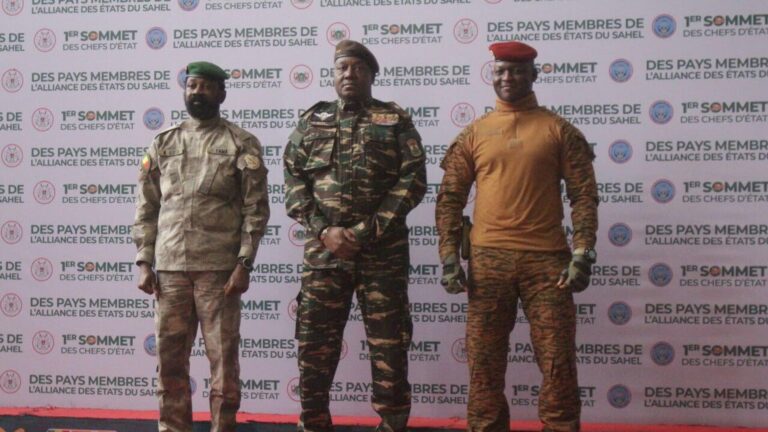
The Alliance of Sahel States (AES) has called on the United Nations to denounce what it describes as repeated violations of its right to access to the sea—violations it claims are politically motivated and contrary to international conventions.
Speaking at the Third United Nations Conference on Landlocked Developing Countries (LLDCs), held in Awaza, Turkmenistan, on Tuesday, August 5, 2025, the AES—represented by Malian Prime Minister General Abdoulaye Maïga—strongly criticised what it called deliberate attempts to isolate its member states logistically, economically, and strategically.
The AES, a confederation of Burkina Faso, Mali, and Niger, reminded delegates that it represents a landlocked region of nearly three million square kilometers and around 75 million people. Despite its abundant natural resources, the region continues to face structural barriers due to its lack of maritime access. These are compounded, the PM said, by unilateral border closures and corridor shutdowns viewed as tools of political coercion.
Referencing the 1982 United Nations Convention on the Law of the Sea (UNCLOS) and the 1965 Convention on Transit Trade of Landlocked States, the AES reaffirmed the conference that access to and from the sea is a legally binding right. The confederation claims that this right has been increasingly restricted over the past two years, with trade routes being weaponised amid regional tensions and diplomatic realignments.
Three coastal countries—Guinea, Mauritania, and Togo—were specifically commended for their “constructive” positions. According to the AES, these states have kept their borders and trade corridors open, despite external pressure to do otherwise.
The AES’s participation in the conference comes as part of a broader effort to reassess the Vienna Programme of Action (2014–2024), one of the core focus areas of the Awaza summit. The alliance also emphasised the need to make the upcoming decade one of economic and logistical catch-up for landlocked developing nations.
Among the initiatives already launched, the AES highlighted plans to establish a Confederal Investment and Development Bank by the end of 2025. The institution will support projects related to infrastructure, energy, industrialisation, and economic diversification. The confederation also stressed the importance of local value addition in raw material processing to reduce dependence on external supply chains.
On the security front, the Malian Prime Minister cited ongoing military operations across the Sahel, claiming substantial gains in dismantling armed groups. He reiterated allegations—previously made in other international forums—of foreign state support for these militias.
In the fiscal domain, the AES voiced support for the ongoing negotiation of a UN Framework Convention on International Tax Cooperation, linking greater transparency in global trade, the fight against multinational tax avoidance, and domestic resource mobilisation. Binding rules in this area, the bloc argues, would significantly reduce losses from extractive industries.
The speech concluded with a call to reform global risk assessment frameworks applied to landlocked countries, which the AES views as excessively punitive in terms of access to international finance. The bloc proposed that by 2030, international financial institutions adopt context-sensitive criteria that reflect the realities of low-income landlocked states.
Throughout its address, the AES challenged the persistent narrative of crisis in the Sahel, instead highlighting a strong political will for recovery, resilience, and regional integration. It reaffirmed its openness to international cooperation, but insisted on the need to respect the sovereignty and strategic choices of its member states.
MD/ac/lb/as/APA