





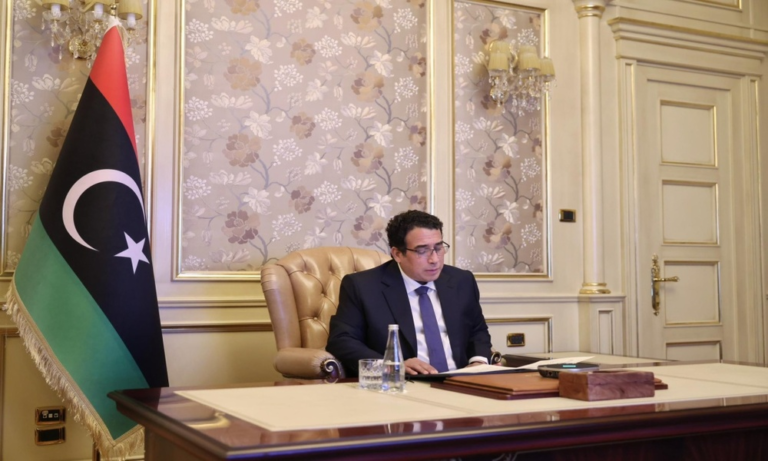
Libyan Presidential Council Chairman Mohammed Menfi has convened the country’s main institutional leaders in Tripoli on October 18 in a fresh attempt to bring rival authorities closer together, as their differences continue to undermine the political transition.
Menfi has invited Aguila Saleh, Speaker of the House of Representatives; Mohammed Takala, President of the High Council of State; and Abdul Hamid Dbeibah, Prime Minister of the Government of National Unity (GNU), to attend the second meeting of the High Council of Presidencies, scheduled for Sunday, October 18, in Tripoli.
The invitation also extends to Presidential Council members Abdullah Al-Lafi and Moussa Al-Koni. The initiative comes amid persistent institutional rivalries and difficulties in establishing a consensual political framework.
According to Menfi, the meeting follows the Tripoli Declaration of November 20, 2025, which announced the creation of this coordination mechanism.
It is intended to provide a framework for harmonising sovereign decisions on the next stages of the political process, without encroaching on the constitutional powers of existing institutions or generating additional administrative expenditure.
The initiative nevertheless raises a key question: can additional consultation mechanisms deliver tangible results when rival institutions are already struggling to agree on the rules governing the exercise of power?
The Presidential Council chairman has urged the invited leaders to set aside their differences and address economic and security challenges collectively.
He has also denounced attempts at foreign interference, a recurring theme in Libyan political discourse.
Since the fall of Muammar Gaddafi’s regime in 2011, rivalries among political forces, territorial authorities and armed groups have complicated efforts to rebuild a unified state.
External influence has also contributed to the internationalisation of these power struggles, making national compromises more difficult to sustain.
The initiative also follows an announcement concerning the leadership of the House of Representatives.
According to reports, Tobruk-based lawmaker Al-Saleheen Abdulnabi Al-Obeidi was elected Speaker of Parliament, replacing Aguila Saleh.
The implications of this development for the institutional balance remain unclear, but it could alter the balance of power within the parliamentary camp and influence forthcoming discussions.
The attendance of the officials summoned for October 18 will therefore provide an initial indication of the institutions’ ability to overcome their differences.
MK/AK/Sf/lb/as/APA