





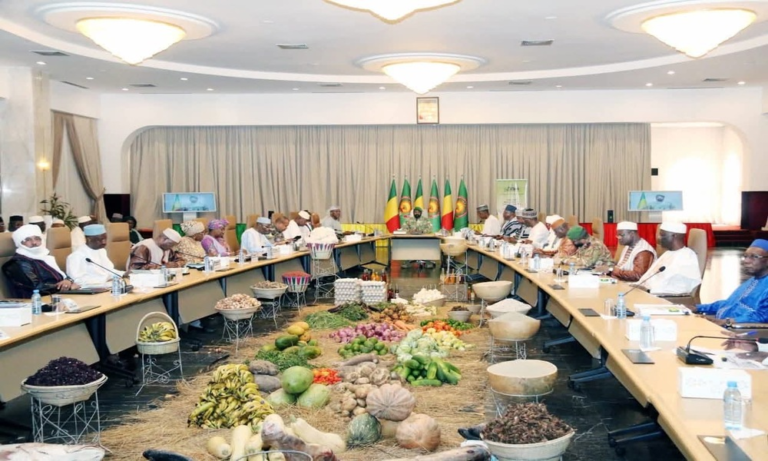
Mali’s High Council for Agriculture held its 16th session on 9 June 9, 2026 in Koulouba, on the eve of the launch of the new farming season.
The meeting reviewed the results of the previous campaign, addressed concerns raised by rural stakeholders and set out strategic priorities aimed at boosting productivity and strengthening food security.
Established under the Agricultural Framework Law, the High Council for Agriculture serves as a consultation platform between public authorities and stakeholders in Mali’s rural sector.
The 16th session brought together, under the chairmanship of Transition President Assimi Goïta, the Prime Minister, ministers in charge of agriculture, livestock, fisheries and food security, as well as representatives of the Permanent Assembly of Malian Chambers of Agriculture and rural professional organizations.
The session followed preparatory work carried out by the National Executive Committee for Agriculture in April 2026.
That committee reported production of 11,452,540 tonnes of cereals for the 2025 season, alongside 433,700 tonnes of cotton, 157,775 tonnes of inspected meat, 17,238 tonnes of collected milk and 122,671 tonnes of fish.
For the 2026 campaign, projections point to 11,916,750 tonnes of cereals and 598,500 tonnes of cotton. These targets reflect the authorities’ determination to strengthen food crop production and revive the cotton sector, which remains a key source of rural income, exports, and agro-industrial activity.
Agriculture continues to play a central role in Mali’s economy and employment. However, the sector remains highly exposed to climate variability, insecurity, limited access to inputs, market disruptions and financing constraints.
Food security remains a major concern for the upcoming season. The 2026 National Response Plan targets around four million beneficiaries and includes the provision of 20,000 tonnes of emergency cereal assistance.
Humanitarian analyses also estimate that about 1.6 million people could face acute food insecurity during the lean season.
The council’s policy directions focus on improving productivity, expanding access to agricultural inputs, strengthening farmer support services, securing production zones, enhancing value chains and reinforcing food sovereignty.
The authorities said that the success of the 2026 season would depend on rainfall levels, input availability, access to farmland, the security situation and the capacity of technical services to support producers.
MD/te/Sf/lb/gik/APA