





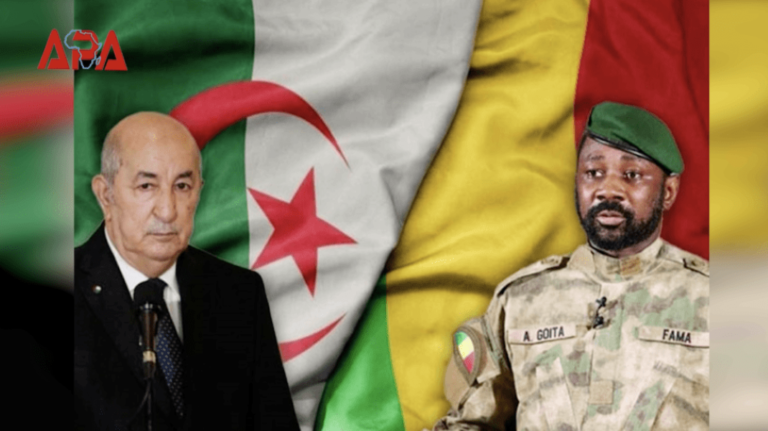
The return of ambassadors and the reopening of airspace have revived dialogue between Bamako and Algiers. However, the fate of Mahmoud Dicko, the drone dispute and accusations of support for armed groups remain unresolved.
Malian Foreign Minister Abdoulaye Diop received Algeria’s ambassador to Mali, Kamal Retieb, on Monday, July 20, in a meeting officially focused on the “revitalisation of cooperation and friendship relations” between the two countries. The meeting came ten days after both sides decided to restore diplomatic ties through the return of ambassadors and the reopening of airspace for civilian and military flights. General Mohamed Amaga Dolo resumed his duties as Mali’s ambassador in Algiers, while Kamal Retieb returned to his post in Bamako.
The measures announced on July 10 put an end to the main restrictions introduced during the diplomatic crisis that began in April 2025. They restored official channels between two countries sharing more than 1,300 kilometres of border and facing similar cross-border security threats. However, the statements issued by both sides did not mention any political roadmap, joint security mechanism or agreement aimed at resolving the disputes that led to the diplomatic breakdown.
Mahmoud Dicko’s situation remains unresolved
The first major deterioration in relations dates back to December 2023, when Algerian President Abdelmadjid Tebboune received Imam Mahmoud Dicko in Algiers. Malian authorities at the time accused Algeria of holding meetings, without consultation with Bamako, with figures considered hostile to the transitional government and with representatives of former armed groups that signed the 2015 peace agreement. Mali summoned the Algerian ambassador before recalling its own representative from Algiers.
Mahmoud Dicko has since been living in Algeria. A former president of Mali’s High Islamic Council, he played a central role in the M5-RFP protests that weakened President Ibrahim Boubacar Keïta before his overthrow in August 2020. He later opposed the extension of military rule, the constitution adopted in 2023 and the postponement of elections intended to end the transition.
His announced return on February 14, 2025, was cancelled after the deployment of a significant security presence in Bamako. According to security sources, a service order issued on the eve of his planned return referred conditionally to alleged “subversive activities” and instructed authorities to prevent any gatherings in the capital. Since the resumption of diplomatic dialogue, no official statement has clarified whether the imam will be allowed to return to Mali, whether he is subject to formal legal proceedings or whether guarantees have been negotiated with Algiers.
Drone dispute remains legally open
The crisis reached its peak during the night of March 31 to April 1, 2025, when the Algerian military shot down a Malian drone near Tinzaouatène. Algiers said the aircraft had entered Algerian airspace by two kilometres, left it and then returned on what it described as a hostile trajectory. Bamako rejected this account and submitted coordinates to the United Nations indicating that the aircraft was lost approximately 9.5 kilometres south of the border, inside Malian territory.
Mali described the drone’s destruction as an act of aggression aimed at disrupting an operation against armed groups. Mali, Burkina Faso and Niger recalled their ambassadors in solidarity within the Alliance of Sahel States, while Algeria took reciprocal measures and closed its airspace to Malian flights.
In September 2025, Bamako brought the dispute before the International Court of Justice. The court transmitted Mali’s application to Algeria but clarified that no proceedings could begin unless Algeria accepted the court’s jurisdiction. No withdrawal of Mali’s application or Algerian consent to the court’s authority has been announced as part of the July 2026 rapprochement.
Accusations over support for armed groups remain
The tensions go beyond the drone incident. Since fighting resumed in northern Mali, Bamako has repeatedly accused Algiers of hosting, protecting or supporting leaders of armed movements active against the Malian state. Algeria has rejected these accusations, saying it supports Mali’s territorial integrity and a political solution based on dialogue with northern populations and non-jihadist groups.
On January 25, 2024, Malian authorities announced the immediate termination of the Algiers Peace and Reconciliation Agreement. Signed in 2015 between Bamako and several northern armed movements, the agreement provided for greater decentralisation, the integration of former fighters and improved representation of northern regions. The Malian government cited non-compliance by other signatories and “hostile acts” allegedly attributed to Algeria.
Algiers expressed deep regret and warned that abandoning the agreement could threaten stability in Mali and the wider region.
The verbal confrontation intensified further in September 2025 before the United Nations General Assembly. Malian Prime Minister Abdoulaye Maïga accused Algeria of becoming a “promoter and exporter of terrorism” in the Sahel and called on it to end any support for groups fighting Mali. These accusations have not been publicly withdrawn since diplomatic relations were restored.
The issue remains particularly significant as areas near the Algerian border continue to be at the centre of military operations. In July 2026, the Azawad Liberation Front and JNIM, Al-Qaeda’s Sahel branch, carried out new attacks against Malian forces and their Russian partners around Anéfis and along the route to Gao. Malian authorities have announced no bilateral arrangements with Algeria regarding intelligence-sharing, border surveillance or the movements of armed groups.
Russia: A mutual friend
Relations with Moscow represent another factor in the rapprochement. Algeria maintains a longstanding partnership with Russia, strengthened in June 2023 through a declaration on deepening their strategic partnership. Russia also remains Algeria’s main arms supplier, accounting for 48% of Algerian imports of major weapons between 2020 and 2024, according to SIPRI.
Mali, for its part, has placed Russia at the centre of its new defence policy following the withdrawal of French forces and the United Nations mission. From December 2021, several Western governments and international sources attributed the deployment of Russian fighters in Mali to the Wagner Group. Bamako has consistently rejected this description, denying the presence of a private military company and stating that it hosts only “Russian instructors” under a bilateral agreement aimed at strengthening national forces.
In June 2025, Wagner itself announced the end of its mission in Mali, although Malian authorities had never officially acknowledged its presence under that name. The official discourse has since changed regarding Africa Corps: statements from the Malian Armed Forces openly describe it as a partner and refer to its support for joint operations on combat fronts.
This Russian presence has already raised concerns in Algiers. After the Tinzaouatène clashes in July 2024, Algeria’s representative to the United Nations criticised the actions of “private armies” used by certain states. President Tebboune also criticised the use of mercenaries in Mali and Libya while maintaining Algeria’s strategic relationship with Moscow.
No official source has attributed a mediating role to Russia in the decisions announced on July 10, 2026. Algerian and Malian statements present the return of ambassadors and the reopening of airspace as decisions taken by the two heads of state, without mentioning any foreign intermediary or addressing the presence of Africa Corps near the Algerian border.
For now, the rapprochement has restored the basic mechanisms of dialogue without announcing any settlement of the underlying disputes. Mahmoud Dicko’s status in Algeria, the proceedings before the International Court of Justice, mutual accusations linked to armed groups, the future of the Algiers Agreement and the Russian military presence remain absent from official statements issued since July 10.
MD/ac/lb/as/APA