





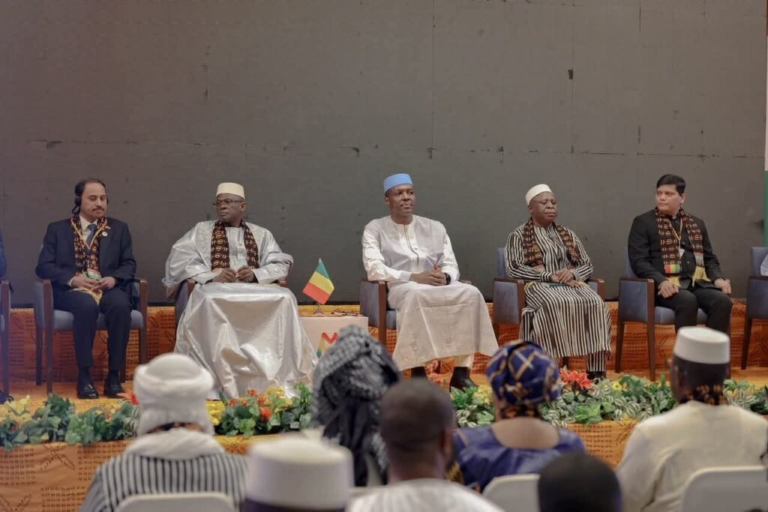
The inaugural Mali-India Export Promotion Forum opened Thursday in Bamako, aiming to convert growing bilateral trade into more structured, long-term economic partnerships.
Held at the Radisson Collection Hotel, the opening ceremony was chaired by Malian Prime Minister Major General Abdoulaye Maïga, representing Transition President Assimi Goïta. Centered around the theme “Strengthening Trade and Strategic Partnerships,” the event is jointly organized by Mali’s Ministry of Industry and Commerce, the Indian Embassy in Bamako, and the Malian Export Promotion Agency (AMAPEX). In his keynote address, Prime Minister Maïga hailed the forum as a milestone in deepening economic ties between the two nations, emphasizing Mali’s commitment to diversifying its export markets, adding value to its local commodities, and attracting investment into high-growth sectors.
The event brings together an official Indian delegation led by Sunil Kumar, Joint Secretary for Trade with Africa, alongside roughly 30 business leaders representing sectors spanning agriculture, agribusiness, energy, renewables, textiles, manufacturing, automotive, construction, pharmaceuticals, healthcare, tourism, and mining. Ahead of the official launch, India’s Ambassador to Mali, Dr. N. Nandakumar, and Head of Chancellery, Dr. Praveen Kumar, outlined the forum’s core objectives during a press briefing. The comprehensive agenda features detailed presentations on trade policies and regulatory frameworks for both countries, targeted B2B matchmaking sessions, and specialized panels focused on export financing and partnership sustainability.
According to the latest figures, bilateral trade surpassed $326 million between April 2025 and March 2026, with Malian exports to India reaching $198 million and outstripping India’s exports to Mali. Mali’s primary exports include cotton, Arabic gum, cashew nuts, sesame, and lead, while India chiefly supplies pharmaceuticals, industrial equipment, machinery, and rice. This upward trade momentum is heavily backed by India’s Duty-Free Tariff Preference (DFTP) scheme for developing nations, which helped drive Malian exports to India to a surge of $16.5 million in September 2025—a 121% increase from the $7.47 million recorded during the same period the previous year. Organizers expect this inaugural edition to yield concrete commercial contracts, Memorandums of Understanding (MoUs), the establishment of a Joint Mali-India Committee, and greater backing from financial institutions for export projects, with the ultimate goal remaining the translation of economic potential into tangible results for businesses and export industries alike.
MD/te/Sf/lb/abj/APA