





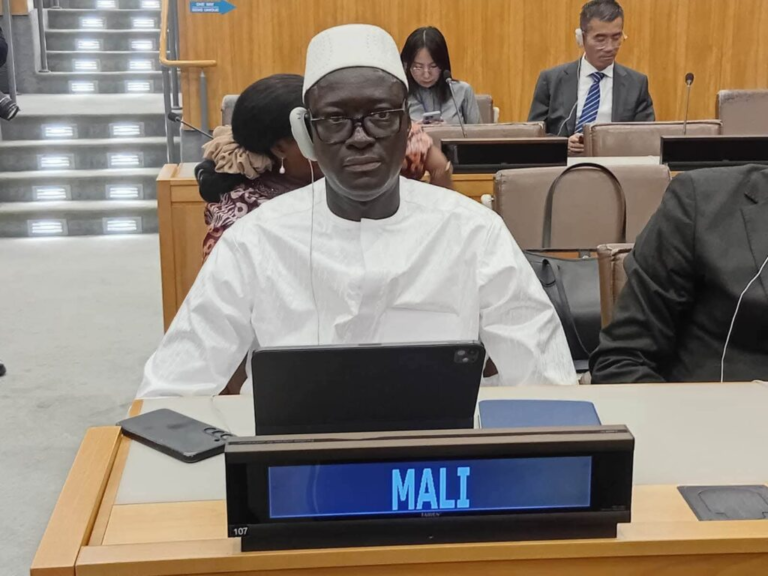
The Executive Boards of the United Nations Development Programme (UNDP) and the United Nations Population Fund (UNFPA) formally approved new cooperation frameworks for Mali on Wednesday, August 26, in New York.
Spanning the 2027–2031 implementation period, the joint initiatives carry a combined budget of $173.1 million, with $130.2 million allocated to UNDP interventions and $42.9 million dedicated to UNFPA programming. While $39.9 million is funded directly through regular agency resources, the remaining $133.2 million—representing nearly 77 percent of the total envelope—must be secured through co-financing and international partner mobilization. Addressing the assembly, Mali’s Permanent Representative to the United Nations, Issa Konfourou, urged global partners to actively assist in securing the necessary funding.
The UNDP framework allocates $47.9 million toward driving economic transformation, developing local value chains, advancing renewable energy, and building climate resilience. A further $82.3 million is earmarked to support public sector governance, judicial access, modernizing administrative services, social cohesion, and peacebuilding efforts. Specific targets under the UNDP plan include lowering Mali’s national poverty rate from 43.3 percent in 2024 to 37.35 percent by 2031, expanding the national share of renewable energy from 11.3 percent to 25.65 percent, doubling restored land areas to 78,292 hectares, and increasing access to free legal assistance to reach 200,000 citizens.
Concurrently, UNFPA will direct $18.2 million toward improving sexual, reproductive, maternal, and neonatal healthcare, while assigning $17 million to combat gender-based violence, child marriage, and female genital mutilation. Additional allocations include $6.3 million to fortify national statistical systems and demographic tracking, alongside $1.4 million reserved for overall program coordination. The agency’s objectives aim to expand modern family planning access to one million new users, increase the number of communities publicly rejecting harmful practices from 400 to 750, and triple youth outreach on reproductive health and peacebuilding to 900,000 individuals.
These targeted measures respond to significant demographic realities in Mali, where annual population growth stands at 3.3 percent, the total fertility rate is six children per woman, and nearly 70 percent of the population is under 25 years of age. Social and health indicators further underscore the urgency, with maternal mortality recorded at 325 deaths per 100,000 live births, 28 percent of adolescent girls experiencing pregnancy, and nearly half of young women married before age 18. Both UN frameworks align directly with Mali Vision 2063 and the National Strategy for Emergence and Sustainable Development 2024–2033, with full implementation set to begin in 2027 through detailed annual work plans.
MD/te/Sf/lb/abj/APA