





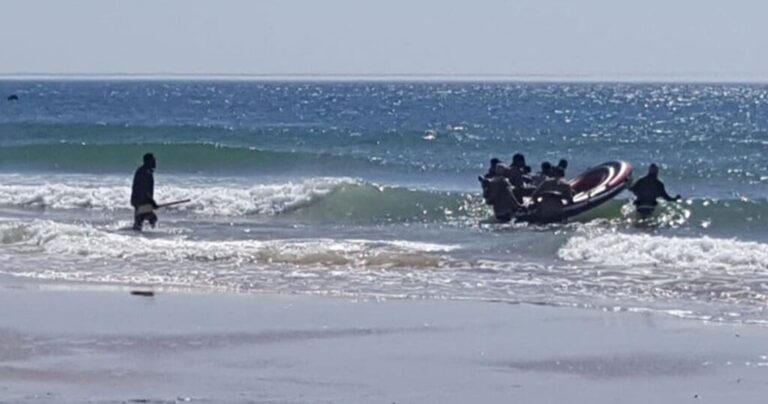
Burkinabe nationals were among the hundreds of migrants rescued by the Mauritanian coast guard between late May and early June 2026 as they attempted to reach the Canary Islands.
These rescue operations, which assisted more than 880 people in an eight-day span, took place in a context where the Atlantic route remains one of the most dangerous migration paths in the world. According to Mauritanian authorities and the media outlet L’Authentique, several successive waves of interceptions of irregular migrants were carried out between May 28 and June 4, 2026. In total, 435 migrants were rescued between May 28 and 30, another 143 people were saved on May 31, and an additional 110 individuals were rescued in rough seas after their engines completely failed. A final boat departing from Banjul, Gambia, was intercepted on June 6 with 193 passengers on board, including women and minors, while one death and one emergency medical evacuation were officially reported.
These repeated rescues vividly illustrate the ongoing, relentless pressure on West African migration routes to Europe, despite strengthened maritime surveillance and stricter border externalization policies. The year 2025 had already heavily highlighted the devastating scale of the migration crisis. An extensive report by the NGO Caminando Fronteras counted at least 3,090 deaths and 303 tragedies on the routes between Africa and Spain up to December 2025, cementing the Atlantic border’s reputation as one of the deadliest migration corridors globally.
The Mauritanian route appeared to be the most lethal path of all, accounting for 1,319 victims and numerous boats completely lost at sea. The document also highlighted a major contradiction, noting that a decrease in attempted crossings in 2025 was paradoxically accompanied by a distinct increase in the risk of mortality. This trend was linked in particular to slow response times and rescue operations deemed insufficient or tightly constrained by border control measures. The NGO thus highlights a structural system where migration management, outsourced to several West African countries including Mauritania, Senegal, and Morocco, contributes to complicating migration routes without sustainably reducing departures, while further exposing vulnerable migrants to shipwrecks and peril at sea.
Consequently, the rescue operations of May and June 2026 are part of a deeply paradoxical dynamic. There is a visible intensification of maritime rescues in the face of persistent irregular departures, all unfolding against a backdrop of increasingly perilous migration routes and growing political pressure on coastal states. The Mauritanian coast guard, for its part, asserts that all rescued individuals receive proper care and processing in strict accordance with humanitarian conventions and international maritime law.
HO/ac/Sf/fss/abj/APA