





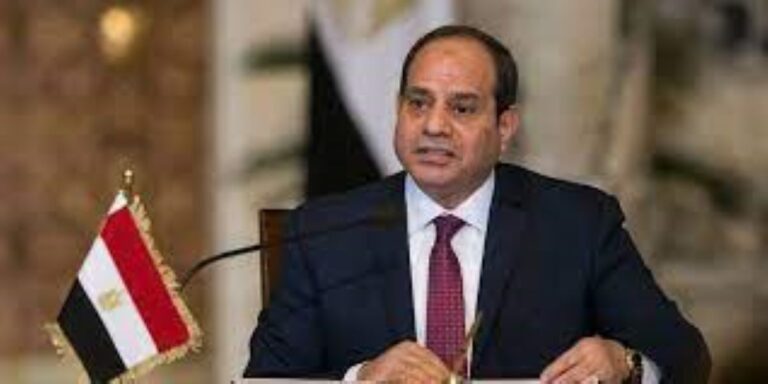
Egyptian President Abdel Fattah el-Sisi has warned of the repercussions of the widening conflict in the Middle East on global prices, energy markets and Red Sea navigation.
He issued this warning during talks on Monday in Cairo with Ajay Banga, President of the World Bank Group, according to a statement from the Egyptian presidency.
“Egypt’s position remains steadfast in favour of the peaceful resolution of crises,” President Sisi reaffirmed.
During the meeting, the two sides reviewed regional developments and Egypt’s ongoing efforts to contain the current escalation.
The talks came on the third day of open hostilities involving Iran, the United States and Israel — an escalation that has plunged domestic and international markets into deep uncertainty.
President Sisi cautioned that the intensifying tensions threaten the security, stability and resources of the region’s peoples. He noted that Egypt has already suffered losses of approximately $10 billion in Suez Canal revenues in recent years due to the war in Gaza.
“The national economy is also under strain from hosting 10 million foreign nationals who have fled conflicts in their respective countries,” the Egyptian leader said.
According to Sisi, these individuals receive the same public services as Egyptian citizens, without the country receiving corresponding financial support — an assessment echoed by the head of the World Bank Group.
Since Saturday — the day strikes on Iran began — the world’s three largest shipping lines, MSC, Maersk and CMA CGM, have suspended vessel transits through the Strait of Hormuz and the Bab el-Mandeb Strait leading to the Suez Canal, opting instead to reroute around Africa via the Cape of Good Hope.
Iran’s Islamic Revolutionary Guard Corps announced on Saturday the closure of the Strait of Hormuz — a critical chokepoint through which roughly a quarter of the world’s oil and one-fifth of global liquefied natural gas supplies transit — citing security risks stemming from U.S. and Israeli attacks.
The Israeli-American military campaign launched Saturday against Iran has entered its third day, disrupting air and maritime traffic and affecting hydrocarbon production facilities across the region. Oil and gas prices have surged sharply in response.
AK/te/lb/as/APA