





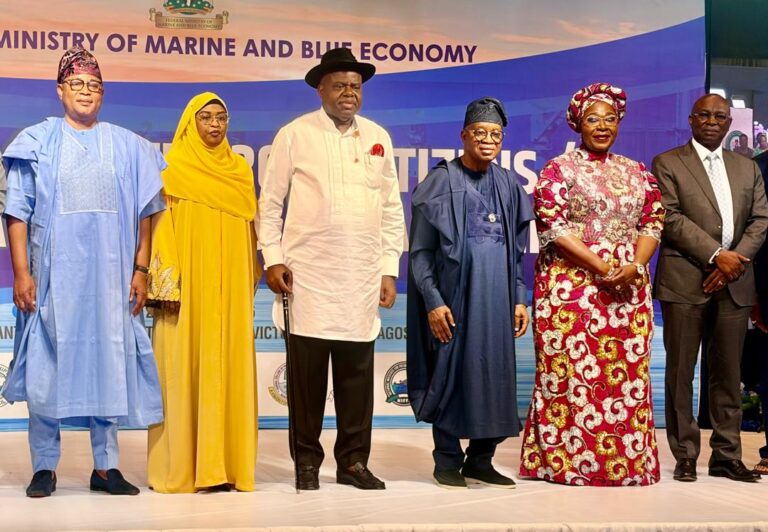
Nigeria’s minister of Marine and Blue Economy, Dr Adegboyega Oyetola, has called for stronger collaboration between the Federal Government, state governments, the private sector and development partners to accelerate the implementation of Nigeria’s National Policy on Marine and Blue Economy, describing sub-national participation as critical to unlocking the sector’s vast economic potential.
Speaking on Thursday at the Second Quarter 2026 Citizens’ and Stakeholders’ Engagement of the Federal Ministry of Marine and Blue Economy in Lagos, Oyetola said that Nigeria had moved beyond policy formulation and should now focus on implementation capable of delivering measurable economic benefits.
The minister said that the National Policy on Marine and Blue Economy had provided a strategic framework for harnessing Nigeria’s oceans, inland waterways, fisheries and coastal resources, but stressed that its success depended on coordinated action across all levels of government.
According to the minister, many of the country’s blue economy assets are located within states and communities, making sub-national governments indispensable partners in driving investment, creating jobs, improving food security and promoting environmental sustainability.
Oyetola said that the reforms under President Bola Ahmed Tinubu’s Renewed Hope Agenda had strengthened stakeholder engagement, attracted investment, improved maritime safety and enhanced the competitiveness of Nigeria’s ports.
He cited the 2025 Container Port Performance Index by the World Bank and S&P Global Market Intelligence, which ranked Tin Can Island Port as the tenth most improved port globally and Lagos Port Complex, Apapa, as the twelfth most improved between 2020 and 2025.
He added that ongoing port modernisation and plans to develop new deep seaports in states, including Akwa Ibom, Bayelsa, Cross River, Lagos and Ondo would further strengthen Nigeria’s position as West Africa’s preferred maritime hub.
The minister also noted that improved port operations has contributed to Nigeria recording a national trade surplus consistently since 2024.
Speaking on inland waterway safety, he said that the ministry had intensified collaboration with relevant agencies and state governments, distributed life jackets nationwide and urged states to replace unsafe wooden passenger boats with modern fibre boats.
He also called on coastal states to align their development plans with the national policy while encouraging private investment in fisheries, aquaculture, maritime transport, tourism, shipbuilding, renewable energy and marine biotechnology.
The theme of the engagement was ‘From Policy to Action: Mobilising Sub-National Governments for Effective Implementation of Nigeria’s National Policy on Marine and Blue Economy,’and it brought together government officials, diplomats, development partners, industry leaders, academics and representatives of state governments.
GIK/APA