



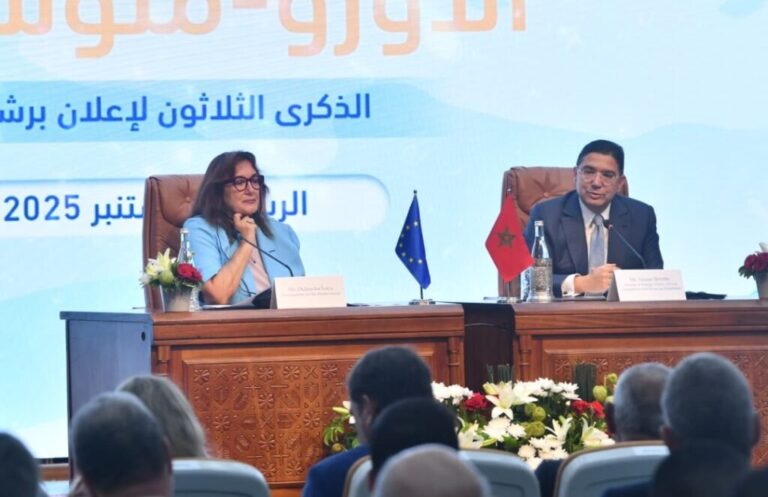
Moroccan Foreign Minister Nasser Bourita on Thursday in Rabat called for a profound overhaul of the Euro-Mediterranean Partnership, arguing that it must become a framework for concrete results and balanced cooperation between North and South.
Speaking at the opening of the High-Level Retreat on “The Future of Euro-Mediterranean Relations”, the Moroccan top diplomat delivered a scathing assessment of the Union for the Mediterranean (UfM) and the process launched nearly thirty years ago.
“Much more than a sea or a border, the Mediterranean is a common good that must bring us together,” Bourita said, stressing the need to overcome political blockages and the asymmetry of expectations between the two shores.
He denounced an “ontological indecision” about the identity of the process, an “asymmetry of motivation” between northern countries focused on security and southern countries aspiring to development, as well as an “inability to manage crises,” whether health, energy, or food related. In his view, Euromed also suffers from a “deficit of social visibility,” perceived as an elitist project detached from citizens.
To break these deadlocks, Bourita proposed a roadmap built on four pillars: securing strategic supplies of energy and food, connecting economies through corridors linking the Mediterranean, Africa, and the Atlantic, harnessing talent by turning migration into an opportunity, and refounding political dialogue through a Mediterranean Forum.
To implement this vision, he advanced the idea of “voluntary coalitions” bringing together at least one northern and one southern country around targeted projects, financed by a Euro-Mediterranean Cohesion Fund. This hybrid mechanism, he explained, should be backed by guarantees and accountability requirements in order to restore the social legitimacy of the process.
By hosting this strategic meeting, Rabat seeks to assert its role as a credible and experienced platform for Euro-Mediterranean dialogue. The retreat brings together officials, business leaders, and researchers to shape the contours of a re-imagined partnership at a time when the Mediterranean stands at the crossroads of geopolitical tensions and global challenges.
MK/ac/sf/lb/as/APA