





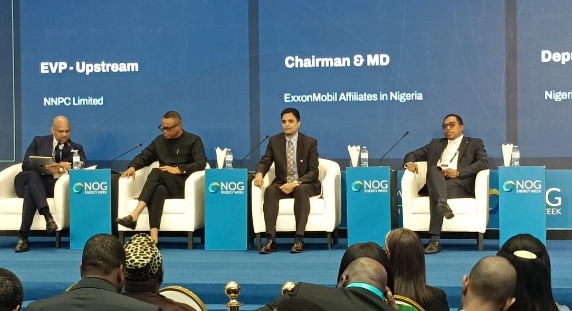
The Chief Executives of the Nigerian National Petroleum Company Ltd (NNPCL), ExxonMobil and Nigeria Agip Exploration (NAE) have observed that greater collaboration through shared infrastructure, improved operational efficiency and sustained efforts to reduce project costs are helping to drive renewed investment in Nigeria’s offshore oil and gas sector.
Speaking during the strategic panel session titled “Maximising Offshore Investment – Succeeding in Complex Energy Frontiers” at the 2026 NOG Energy Week in Abuja on Wednesday, the panelists agreed that recent reforms have renewed investor confidence in Nigeria’s deepwater sector and that continued collaboration among operators and cost discipline would determine how quickly new projects are delivered.
In his contribution, Udy Nnadi, Executive Vice President, of the Upstream division of the NNPCL, stated that operators are increasingly looking beyond individual developments to shared infrastructure and coordinated project execution to improve project economics.
He explained that opportunities exist for companies to collaborate on floating production, storage and offloading, FPSO, facilities, subsea infrastructure and offshore campaigns, rather than developing projects independently.
According to him, planning such collaborations from the early stages of projects can shorten development timelines, optimise existing assets and reduce capital and operating costs.
“The number one driver of business today is cost. We need to bring our costs down while continuing to maximise value,” he said.
Nnadi added that the NNPCL is encouraging greater cooperation across the industry, including cluster developments and coordinated offshore campaigns that allow operators to share resources and infrastructure where practical.
In his remarks, the Chairman and Managing Director of ExxonMobil Affiliates in Nigeria, Mr. Jagir Baxi, disclosed that Nigeria’s deepwater industry has witnessed a significant turnaround in investor sentiment over the past few years, although project costs remain relatively high compared with competing investment destinations.
He explained that ExxonMobil’s permanent shore base under development at the LADOL Free Zone is intended to improve logistics, create operational efficiencies and support a broader offshore ecosystem that can serve multiple operators.
According to him, the project has received support from the Nigerian Upstream Petroleum Regulatory Commission (NUPRC) and the Nigerian Content Development and Monitoring Board (NCDMB), reflecting a shared commitment to building long-term industry capacity.
Baxi added that increased flexibility in offshore contracting has also enabled operators to deploy rigs and other assets across different projects, improving utilisation and lowering costs.
According to him, sustainable local content should be measured by its ability to remain commercially competitive over the long term rather than by individual project requirements alone.
“The real success will be when these opportunities become routine and Nigeria is globally competitive on cost and execution,” he said.
Similarly, Dr. Richard Oruanzi, Deputy Managing Director of Nigeria Agip Exploration Limited stated that collaboration among operators presents significant opportunities to improve project economics, particularly through the shared use of offshore infrastructure and coordinated development of neighbouring deepwater assets.
He noted that leveraging existing facilities instead of duplicating investments would help unlock additional resources and make more offshore projects commercially viable.
Summing up the discussions, Oliver Onyekweli, Partner at McKinsey & Company, who moderated the panel session noted that Nigeria has re-emerged as a major destination for upstream investment, following the implementation of industry reforms.
He recalled that at the recent Offshore Technology Conference in Houston, USA, international investors expressed growing interest in Nigeria’s offshore opportunities and the changes taking place in the country’s energy sector.
According to him, maintaining that momentum will depend on sustained efforts to lower costs, strengthen collaboration across the value chain and execute projects efficiently.
GIK/APA