





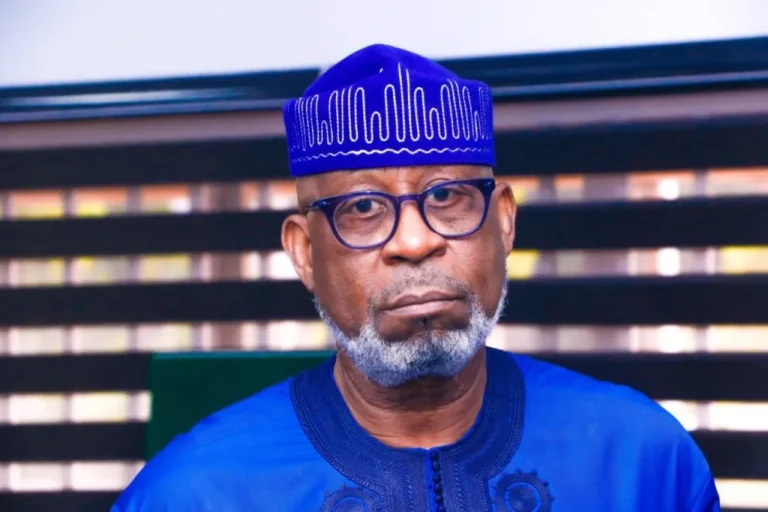
Nigeria’s Minister of Solid Minerals Development, Mr. Dele Alake, has called on the United States of America and African countries to prioritise the development of regional energy hubs as a catalyst for cross-border mining industrialisation and sustainable supply of critical minerals needed for the global energy transition.
Speaking at a high-level panel session themed “Critical Minerals in Africa: Meeting Global Demand” during the ongoing Powering Africa Summit in Washington, D.C, Alake stressed that strategic and sustainable partnerships with Africa remain the fastest route to meeting the rising global demand for critical minerals.
According to the statement issued on Sunday by the minister’s Special Assistant on Media, Segun Tomori, the minister advocated the development of regional industrial corridors across the continent, similar to the Lobito Corridor, noting that such frameworks would unlock vast mineral resources and drive economic transformation.
Alake specifically identified the Lagos–Abidjan corridor, spanning Nigeria, Benin, Togo, Ghana, and Côte d’Ivoire, as well as the Walvis Bay Corridor, as critical belts that could transform Africa’s mining landscape.
He explained that such corridors would not only enhance infrastructure and energy access, but also deepen regional integration and industrial growth.
“The development of nuclear power in one West African country, for instance, can service an entire corridor. With that in place, local beneficiation, technology transfer, manufacturing, and cross-border industrialisation will naturally follow. If three to five such corridors are developed in Africa, we would significantly advance industrialisation across the continent, creating a win-win outcome for both Africa and the West,” Alake said.
The Nigerian minister’s push comes amid intensifying global competition for critical minerals such as lithium, cobalt, and nickel, which are essential for clean energy technologies, including electric vehicles and renewable power systems.
Highlighting Nigeria’s positioning in this evolving landscape, Alake stated that reforms under President Bola Tinubu have significantly improved the attractiveness of the country’s mining sector.
He noted that strengthened governance structures, improved regulatory frameworks, and the digitisation of licensing processes have enhanced transparency and ease of doing business.
According to him, these reforms now guarantee secure tenure for mineral title holders, providing the long-term stability required for investment decisions.
“The administration of President Bola Ahmed Tinubu has strengthened governance structures, improved regulatory frameworks, digitised licensing processes, and enhanced ease of doing business, repositioning Nigeria’s mining sector as a key driver of economic diversification.
“In addition, we are expanding the generation of scientific and internationally certified geological data to support informed decision-making by both local and international investors,” he stated.
On security, the minister acknowledged longstanding challenges but pointed to progress made through the establishment of Mining Marshals to curb illegal activities in the sector.
He disclosed that over 350 suspected illegal miners, including foreign nationals, had been arrested within the past year, with more than 150 currently undergoing prosecution.
“This has sent a clear signal that Nigeria means business. We are sanitising the sector and ensuring that only legitimate operators can thrive,” he added.
GIK/APA