



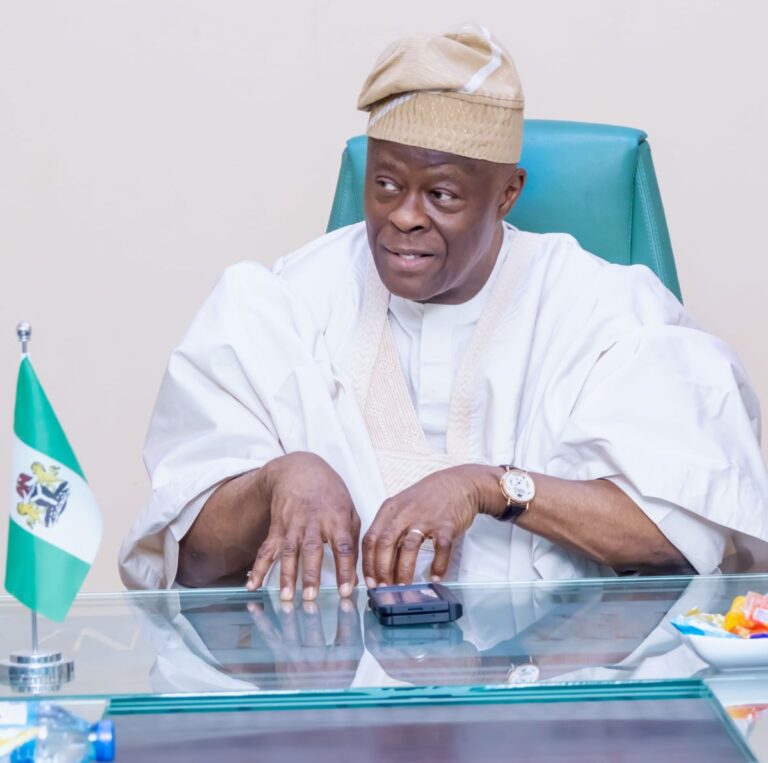
Nigeria’s Minister of Finance and Coordinating Minister of the Economy, Wale Edun, says that Nigeria must reduce its dependence on borrowing and build a stronger, more reliable domestic revenue base to stabilise its finances and fund development sustainably,
Speaking on Tuesday at the management retreat of the Nigerian Revenue Service in Abuja, Edun warned that the global financial environment had become increasingly hostile to developing economies, making debt-driven financing more costly and less viable.
“And of course, we need to reduce our dependence on debt. And so, revenue mobilisation within this context is a developmental imperative,” Edun said.
He noted that the world is retreating from multilateral cooperation, with countries prioritising domestic interests and scaling back cross-border financial support.
This shift has left poorer and developing countries facing an unfavourable balance between what they receive from abroad and what they pay out in debt service.
Edun highlighted that available data for 2024 showed developing countries paid about $163 billion in debt service, compared with $42 billion in overseas development assistance and $97 billion in foreign direct investment, underlining how external funding flows had turned negative.
“This reality means Nigeria has to anchor its fiscal sustainability on its own revenue-generating capacity, rather than continuing to rely on borrowing in an era of high global interest rates and tighter financial conditions,” he said.
“The primary anchor of our fiscal sustainability… is going to be our own fiscal efforts, our own ability to generate savings, which then can be used for investment,” Edun added. “And before you can generate savings, you have to have the revenue.”
He linked Nigeria’s rising debt pressures to global shocks, including the COVID-19 pandemic, geopolitical conflicts, and trade tensions, which have forced many developing countries to borrow more while paying higher debt service. These pressures have squeezed fiscal space, making it more difficult for governments to fund essential services and further reinforcing the need for sustainable domestic revenue.
“That is why it is critical at this time that we move to an era of sustainable revenues so that we can invest meaningfully in infrastructure, strengthen education and healthcare, and help the poorest and most vulnerable,” Edun said.
Edun’s call for Nigeria to rein in borrowing comes amid remarks by the Senate indicating that fresh loans remain inevitable to plug the country’s large budget deficit.
At a public hearing on the 2026 Appropriation Bill, the Chairman of the Senate Committee on Appropriations, Olamilekan Adeola, said that continued borrowing had become unavoidable, given weak revenue inflows and Nigeria’s large infrastructure and development gaps.
“Nigeria cannot help but keep borrowing because revenue inflows are unpredictable and development needs are enormous. What matters is how we borrow and how we fund our deficits,” Adeola said.
GIK/APA