



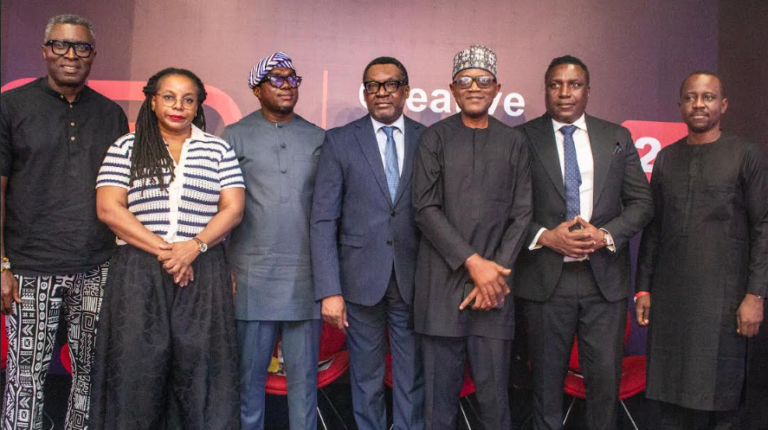
The Stakeholders at the second QEDNG Creative Powerhouse Summit have said that Nigerian creative economy cannot achieve its full potential on talent alone and requires stronger structures, access to finance, skills development and better protection of intellectual property.
The Summit, organised by Mighty Media Plus Network Limited, publishers of QEDNG, on Tuesday in Lagos, with the theme “Creativity, Culture and Nigeria’s Next Chapter” brought together filmmakers, music executives, content creators, journalists, business leaders, government officials and other stakeholders to examine the structures, financing, skills, intellectual property and platforms required to build a sustainable and globally competitive creative economy.
In his address, QEDNG publisher and convener of the summit, Olumide Iyanda, said that the institutional and structural challenges facing creatives remained a major obstacle to the growth of the sector.
“This conversation is actually very personal for me. As I said here last year, I have been around this industry long enough to see talent sprout. I’ve also regrettably seen some of them wither before they could bloom. Not because they didn’t want to fly, but because the institutional and structural backbone that they need is just not there. For every Burna Boy, every Kiekie, every Chimamanda, every Kunle Afolayan, there are thousands who wish they could be like them. Some of them are in this room this morning,” Mr. Iyanda said.
He therefore called for stronger Nigerian platforms capable of supporting and distributing local creative works, saying the stories Nigeria tells about itself should form part of the wider national conversation.
Representing the chairman of the summit Demola Aladekomo, the managing director of SmartCity Plc Gabriel Ukachukwu said that Nigeria needed to build an ecosystem around the creative economy rather than rely solely on individual talent.
“A creative economy requires infrastructure. It requires capital. It requires intellectual protection. It requires skills. It requires distribution. It requires technology. It requires serious business models, Mr. Ukachukwu said, adding that the global creative economy has become too significant for countries to leave its development to chance.
Speaking further, the chairman’s representative said that the “United Nations Trade and Investment ” estimated global export of creative services in 2024 to have reached $1.7 trillion. It tells us that creativity is no longer a margin of the global economy. It is a part of the global economy.”
He said that Nigeria needed to answer three fundamental questions: how to move talent into enterprise, how to finance creativity and how to protect and monetise intellectual property.
“Talent without structure is just a hustle. So how do we move from talent to enterprise? My second question is: How do we finance creativity? The third one is how do we protect and monetize intellectual property,” he continued.
Delivering the keynote address, the national coordinator of the Investment in Digital and Creative Enterprises (iDICE), Ife Adebayo, said that Nigeria had enormous creative talent and cultural influence but needed to build the systems to turn those assets into economic value.
Adebayo used the 1986 American film Top Gun to illustrate the power of storytelling to shape national image and economic outcomes.
He said that the film, which portrayed the United States Navy’s fighter pilots, was followed by a reported surge in applications to join the US Navy.
He challenged Nigeria to consider what its own creative output could achieve if film, music, fashion, comedy and animation were deliberately supported as tools for projecting the country to the world.
“Think about that. The most powerful military on earth, with the largest budget in human history, confessing that it’s most effective recruiter was not a weapon, was not a general, was not a budget line. It was a story. It was culture.”
Adebayo said that Nigeria was also paying a price for leaving important stories untold, recalling the death of a military officer whom he described as a godfather S.K. Umaru, who died in an IED blast while fighting insurgents in 2014.
“What stays with me most is that this story has never been told. And he is one of thousands of men and women who have fought and who are fighting for this country as I stand speaking here to you today.”
He said that Nigeria’s creative economy currently contributes about 1.2 per cent of GDP, compared with close to 3 per cent in South Africa, which he said had built stronger structures around its creative industries.
“The difference is that they count it, they structure it, they finance it. We have the louder voice; they build the microphone, provide a better infrastructure, supported with better policies.”
Adebayo also cited South Korea’s deliberate investment in cultural exports, pointing to the global impact of Korean music, film and television.
He identified skills, capital and structure as major gaps in Nigeria’s creative economy, pointing to shortages in areas such as cinematography, product management and animation, as well as the high cost of accessing professional equipment and expertise.
“The average Nollywood film has historically been made on a budget a fraction of what a single day costs a serious studio abroad. A great script in this country does not die because it is bad; it dies because it is broke,” he declared.
He said better intellectual property protection and clearer pathways from creative ideas to bankable businesses were also needed.
Adebayo disclosed that the iDICE programme had established a $45 million debt fund and a $65 million Islamic finance facility, alongside equity options designed to attract additional private and international investment into Nigeria’s technology and creative sectors.
He urged financiers to regard creative businesses as investable enterprises rather than informal ventures.
“To the financiers in the room and every institution, we should stop treating film like a personal loan and start treating it like the asset class that it has become everywhere else on earth.”
He also called on corporate Nigeria to move beyond sponsorship of creative activities and invest directly in the sector.
“Do not just sponsor the summit; fund the sector.”
Adebayo said the government also had a role to play in protecting intellectual property and creating policies that respond more quickly to the needs of the creative economy.
He urged creatives to continue telling Nigerian stories, arguing that their work could influence how the country is understood at home and abroad.
The Summit, which had theme, the theme “Financing as Catalyst for a Thriving Creative Economy”, was supported by FirstBank, NLNG, Zenith Bank, Fidelity Bank, The Africa Soft Power Group, Lagos State Internal Revenue Service and Polaris Bank.
GIK/APA