





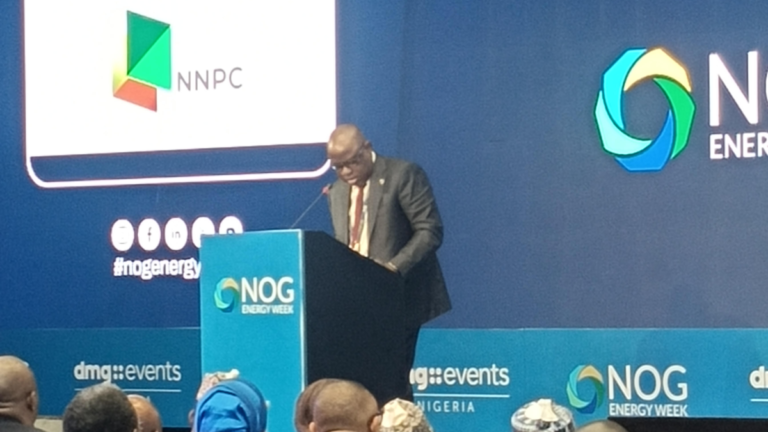
The Group Chief Executive Officer of the NNPC Limited (NNPCL), Mr. Bayo Ojulari, has urged African countries to move away from fragmented national approaches to energy issues and pursue deeper regional collaboration to maximise the continent’s vast energy resources.
Speaking at the 25th edition of NOG Energy Week in Abuja on Tuesday, Ojulari stated that Africa possesses abundant oil, natural gas, renewable energy resources and one of the world’s youngest populations, yet it continues to attract only a small share of global energy investment.
He called for stronger partnerships among governments, national oil companies, financiers, universities, technology developers and service providers to build integrated value chains capable of driving industrialisation.
According to him, the future of Africa’s energy sector will depend less on the size of its hydrocarbon reserves than on the strength of the partnerships built around them.
“The future of Africa’s energy will not be determined solely by the resources beneath our soil. It will be determined by the quality of the partnerships we build,” he said.
Ojulari added that the NNPCL’s long-term vision is to become an ecosystem builder that connects capital, technology, policy, talent and markets to create lasting value for Nigeria and the continent, while supporting industrialisation, energy security and economic prosperity.
Ojulari stated that the NNPCL has shifted from making promises to demonstrating measurable progress, insisting that collaboration across the energy value chain has become the foundation of the company’s transformation agenda.
Reflecting on his address at the 2025 edition of the conference, Ojulari said that the NNPCL had committed itself to rebuilding trust, restoring accountability and repositioning the national oil company into a globally competitive energy enterprise.
“One year later, I remain convinced that performance, transparency and accountability are not optional aspirations. There are the foundations upon which sustainable energy prosperity must be built,” he said.
He argued that Africa’s biggest challenge was not the availability of hydrocarbon resources, but the inability of governments, investors, regulators, operators and financial institutions to work together to convert those resources into economic prosperity.
According to him, fragmented institutions and weak collaboration continue to slow investment and delay project delivery across the continent.
Presenting the NNPCL’s operational performance, Ojulari said that Nigeria recorded a significant improvement in crude oil production between 2024 and 2025 and that the NNPCL intends to consolidate the gains.
According to him, the company has achieved a “step change” in production and it is implementing additional initiatives to sustain the momentum.
He attributed the improvement to stronger partnerships among operators, regulators, security agencies and host communities, while pipeline availability has been sustained at 92 per cent, a development he credited to improved collaboration rather than increased military operations.
Ojulari said that experience had shown that protecting oil and gas infrastructure through force alone was ineffective.
“You cannot survive in the Niger Delta through kinetic solutions alone. You can only succeed through collaboration with communities. We have learnt that lesson,” he said.
He commended the operating companies, host communities and security agencies for working together to reduce disruptions and improve the reliability of oil transportation infrastructure.
Ojulari also reported significant progress in addressing the long-standing issue of Joint Venture cash-call obligations, which had previously constrained investment in the Nigerian upstream sector.
Recalling his commitment at last year’s conference that the NNPCL would no longer owe its Joint Venture partners, he said that the company had prioritised cash-flow management and significantly improved payments.
According to him, most Joint Venture partners are now receiving their cash calls on schedule, while outstanding issues involving a few partners are being resolved.
He announced a “zero tolerance” policy for partners that fail to meet their financial obligations, saying that NNPCL has begun invoking appropriate contractual and legal provisions to enforce compliance.
The improved payment discipline, he explained, is restoring confidence among investors and ensuring projects are executed without unnecessary delays.
GIK/APA