





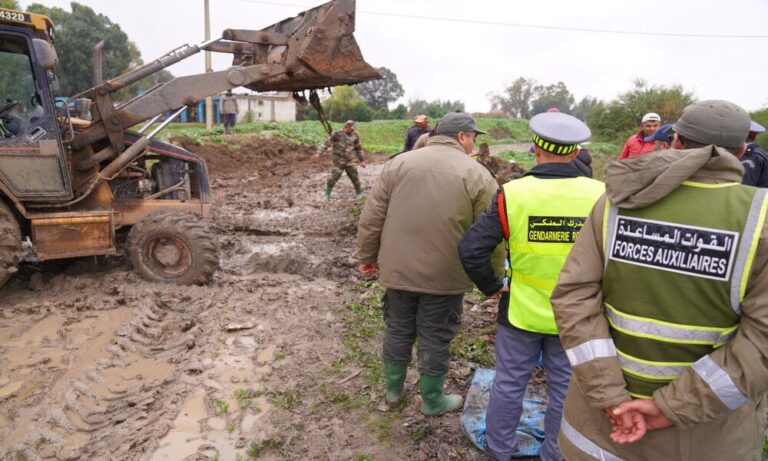
Northern Morocco has been facing severe weather and flooding in recent days, leading the authorities to suspend classes in several regions and close roads.
From Tangier to Ksar El-Kebir, northern Morocco has been grappling with flooding, emergency evacuations, and road closures for several days.
In Ksar El-Kebir, in the province of Larache, authorities have ordered the temporary closure of schools and the evacuation of several affected neighborhoods.
According to the Civil Protection services, the rainfall recorded in just a few hours far exceeds seasonal averages.
In response to this situation, authorities have mobilised significant logistical and human resources, as well as members of the Royal Armed Forces, in accordance with royal directives, to assist and support the populations affected by the floods, particularly in Ksar El-Kebir, where many residents have been evacuated as a precaution.
Due to heavy rains and flooding affecting the region, the Larache Provincial Directorate of Education announced on Saturday the exceptional suspension of classes in schools in Ksar El-Kebir from Monday, February 2nd to Saturday, February 7.
The decision, taken following recommendations from the provincial monitoring unit and in coordination with local authorities and the Tangier-Tetouan-Al Hoceima Regional Academy of Education and Training, aims “to ensure the safety of students and educational and administrative staff,” according to a statement released by the
directorate.
Mohamed El Baali, the provincial director of education, explained that significant rainfall caused flooding and made travel to and from several schools difficult, a circumstance that prompted the temporary suspension of in-person classes.
He specified that the rising water level of the Loukos River led to water seepage in five schools and flooding around several others, preventing normal access to the premises.
The measure affects 69 schools, both public and private, including 27 preschools, and impacts approximately 35,000 students: nearly 15,000 in primary school and some 5,000 in preschool, according to the provincial education authority.
To mitigate the educational impact of this suspension, the authority states that it has implemented a continuity of learning plan: a temporary shift to distance learning and scheduled support and catch-up sessions for subjects affected by the interruption.
Authorities specify that classes will resume “as soon as weather conditions improve and access to schools is restored.”
On Sunday morning, local authorities in the city of Ksar El-Kebir installed dozens of metal barriers at the entrances to several neighbourhoods in anticipation of rising waters in the Loukkos River in the coming hours.
Local media reports indicate that police officers and foot patrols, supported by army and auxiliary forces units, have been mobilised to prevent access to the sealed-off neighbourhoods, while also ensuring the protection of residents’ homes and property.
Local authorities have urged residents of the threatened areas to leave their homes and head to shelters set up for this purpose by the Royal Armed Forces and relevant city services, as part of the preventative measures implemented to address this exceptional situation.
For their part, the provincial directorates of National Education, Preschool, and Sports in the Tangier-Tetouan-Al Hoceima region announced on Sunday the temporary suspension of classes next week due to expected weather disruptions.
Abdelmalek Essaadi University also announced on Sunday the suspension of classes starting February 2, due to the anticipated weather disruptions.
For its part, the Ministry of Equipment and Water announced in a statement that traffic is temporarily interrupted on National Route 1 (RN1) linking Souk Larbaa and Ksar El-Kebir at the southern entrance to the city of Ksar El-Kebir, and on Regional Route 410 (expressway) linking Larache and Ksar El-Kebir at the western entrance to the city of Ksar El-Kebir.
This temporary traffic interruption is due to the rising water level of the Oued Loukkos and the maximum filling of the Oued El Makhazine dam reservoir, which have caused the road to be submerged, the statement specifies.
Faced with the alarming rise in the waters of the Oued Sebou, the authorities of the Sidi Kacem province have launched a series of emergency interventions, combining preventative evacuations, road safety measures, and the protection of people and property.
Local authorities have been working tirelessly, launching preventative evacuation operations for residents of areas threatened by the rising waters of the Sebou River, in order to protect lives and property, according to local media.
Several traffic disruptions have been reported.
Following the severe flooding that occurred on the night of Saturday, January 31, 2026, caused by the release of water from the Al Wahda Dam, rail traffic was temporarily suspended between Sidi Kacem and Mechraa Bel Ksiri. The incident affected train service on the Tangier-Fez line.
The Moroccan National Railways Office (ONCF) has implemented alternative routes, including a detour via Kenitra, to ensure service continuity.
According to the same sources, local authorities and emergency response teams remain on high alert and are continuously monitoring the Sebou River’s water levels to guarantee public safety and intervene immediately if necessary.
For its part, the provincial directorate of the Ministry of National Education, Preschool and Sports in Taounate announced the suspension of classes in all public and private schools in the province on Monday, Tuesday and Wednesday, February 2, 3 and 4, 2026, due to the announced weather disturbances.
AK/ac/Sf/fss/as/APA