



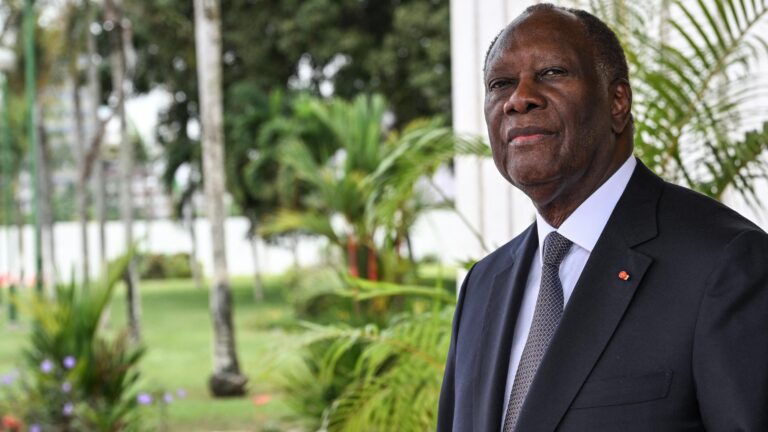
Nearly 15 years after coming to power, President Alassane Ouattara has transformed the Ivorian economic
landscape.
Since 2011, the country has become an African powerhouse, posting growth rates that would put many economies around the world to shame.
But behind the numbers, one question persists: has this growth truly changed the daily lives of Ivorians? When Ouattara came to power in 2011, the country was emerging from a decade of political and military turmoil.
The economy was on its knees. Fourteen years later, the contrast is striking: Côte d’Ivoire recorded an average annual growth rate of more than 8 percent between 2012 and 2019, then maintained the rate at around 6.5 percent through 2025.
Foreign investors are not mistaken: Côte d’Ivoire is now the third-largest country in Africa in terms of attracting FDI, with $3.8 billion received in 2024, just behind Egypt and Ethiopia.
Rating agencies applaud the country’s fiscal discipline, restored stability, structural reforms, and a vigorous economic diversification strategy. “Our resilience has been strengthened by the diversification of the economy,” Alassane Ouattara likes to point out, presenting himself as the guarantor of a country that has become attractive and stable.
From cocoa to black gold
Long dependent on cocoa, Côte d’Ivoire has multiplied its assets. The processing of agricultural raw materials and the rise of the extractive sector, driven by oil and gas, as well as the production of gold, coltan, and manganese, have diversified the country’s growth drivers.
In cashew nuts, for example, gross production increased from 380,000 tonnes in 2010 to over 1.2 million tonnes in 2023, representing nearly 40 percent of global supply. Local processing capacity, which has increased fivefold in less than a decade, exceeded 350,000 tonnes in 2024, generating over 18,000 jobs, two-thirds of which are held by women.
The discovery of the Baleine offshore deposit, located off the coast of Abidjan, in 2021 marked a turning point. In two years, oil production has surged, with a target of 60,000 barrels/day reached by 2024. Abidjan plans to triple this volume by 2027 and has already applied to join OPEC.
The same logic applies to mining. In 2010, the country produced 5 tons of gold. Fourteen years later, it reached a record 58 tons in 2024, and the authorities are aiming for 62 tons by 2025, thanks to the entry into production of new deposits such as Lafigue.
The revision of the mining code has strengthened local content, encouraging the establishment of international players while ensuring the emergence of Ivorian SMEs and creating a ripple effect in mining regions.
Jobs: The promise to young people
Growth is worthless if it doesn’t create jobs. In this area, the authorities put forward a figure: 2.8 million jobs created between 2011 and 2019. In terms of formal employment, the National Observatory recorded 1.4 million jobs in 2023, an increase of 117,000 over one year.
According to the Minister of Youth, the private sector, which generates an average of 100,000 new jobs each year, continues to be the key driver of this dynamic. Industrial zones, infrastructure projects, financial services: opportunities are multiplying.
But nearly 400,000 young people enter the job market each year. This is the equation that the “Vision 2030” strategy aims to address, promising 8 million additional jobs by the end of the decade, focusing on private investment, SMEs, and major structural projects.
A giant objective.
“We must ensure that growth benefits everyone,” Ivorian President Alassane Ouattara regularly repeats, aware that emergence cannot be reduced to simple macroeconomic indicators.
The National Development Plan (PND 2021-2025), with a projected budget of 59 billion CFA francs, has enabled, among other things, the construction of new universities and technical institutes, the deployment of vocational training programs, massive investments in school and health infrastructure, not to mention governance reforms
designed to attract more private investment.
Declining poverty rate
In 2011, at the end of the severe post-election crisis, more than one in two Ivorians lived below the poverty line. By 2021, this rate had already fallen to 37.5 percent, according to World Bank data, an unprecedented decline.
Projections for 2025 reinforce this trend. According to World Bank estimates, the poverty rate is expected to decline further, from 37.1 percent in 2024 to 34 percent in 2025. In other words, a reduction of more than three percentage points in one year, even as the country continues to face persistent structural challenges.
The new National Development Plan (PND 2026-2030) sets a clear ambition: to bring this rate below 20 percent by 2030. But challenges persist, and government action is intensifying to reach the poor neighbourhoods of Abidjan and the villages in the west and north, which serve as a reminder that prosperity must continue to be fairly distributed.
Today, per capita income is around $2,700, compared to around $1,700 in 2010. Alassane Ouattara’s goal is to cross the $4,000 mark by 2030 and position Côte d’Ivoire among the upper-middle-income countries.
To achieve this, it will be necessary to maintain sustained growth, around 6 percent per year, but above all, to make it more inclusive.
This requires increased investment in education, vocational training, and more effective governance.
AP/fss/as/APA