



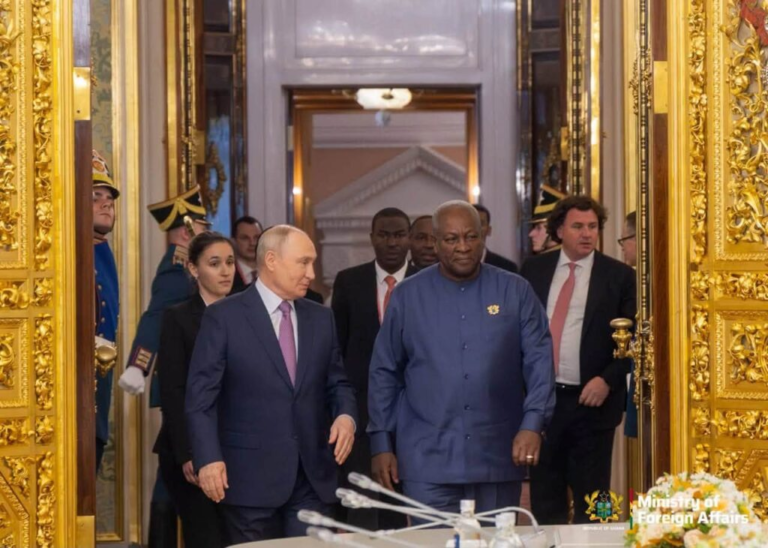
Russian President Vladimir Putin has assured his Ghanaian counterpart, John Dramani Mahama, that Ghanaian nationals would no longer be allowed to take part in the war in Ukraine, including through irregular recruitment or voluntary enlistment.
This is according to a statement issued by the Ghanaian authorities after their meeting in Moscow.
The assurance was reportedly given during talks between the two leaders on 30 October 2026, on the sidelines of the third Russia-Africa Summit, following concerns raised by the Ghanaian president about the involvement of his compatriots in the conflict in Ukraine.
According to the Ghanaian side, the commitment announced by Putin applies to all forms of participation, whether through irregular recruitment or voluntary enlistment.
The issue was one of six commitments outlined by Accra after the bilateral meeting, which also covered cooperation in energy, defence, agriculture and higher education.
The Ghanaian authorities also announced plans to work with Russia on the construction of a 2,000-megawatt nuclear power plant, as well as stronger cooperation in defence and agriculture.
In his public remarks during the meeting, Putin reaffirmed Moscow’s desire to strengthen relations with Accra, noting that the two countries had maintained diplomatic ties since 1958.
He also said that 649 Ghanaian students were currently studying in Russia and that bilateral trade had increased by 6% between January and August 2026.
The recruitment of African nationals to fight in the war in Ukraine has raised growing concern across the continent.
Several countries, including Kenya, South Africa, Nigeria and The Gambia, have raised the alarm over practices in which young people are lured to Russia with false promises of paid jobs, security positions or study opportunities before being enlisted in military operations.
Estimates suggest that around 1,500 African fighters from countries including Kenya, South Africa, Nigeria, Ghana and Tanzania have been recruited. The recruitment is reportedly carried out through networks of intermediaries who exploit the economic vulnerability of people seeking to migrate, offering them civilian contracts that may ultimately lead to deployment on the Ukrainian front.
AC/Sf/lb/as/APA