





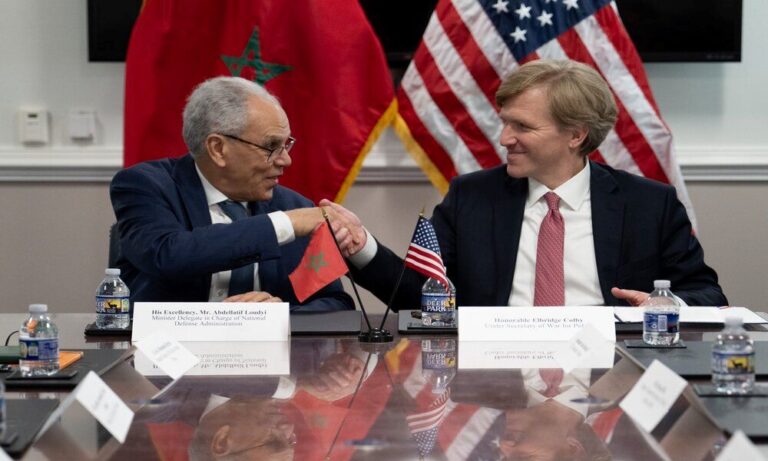
A strategic agreement signed in the United States revamps a long-standing military partnership between Rabat and Washington for the next ten years.
The signing of a new roadmap for defense cooperation between the United States and Morocco was announced following a meeting held at the Pentagon between Abdellatif Loudiyi, Minister Delegate in charge of the National Defense Administration, and Lieutenant General Mohammed Berrid, Inspector General of the Royal Armed Forces, as well as senior American officials.
The agreement aims to frame bilateral relations in the military field for the next decade, according to an official American statement.
This renewed framework builds upon a historic partnership between the two countries, established more than two centuries ago.
The American authorities noted that Morocco was the first state to recognise the United States, a point regularly emphasised to highlight the strength and longevity of this strategic relationship.
The new roadmap aims to consolidate existing cooperation mechanisms while adapting priorities
to current security challenges.
Operationally, the document should guide coordination between the armed forces of the two countries, particularly in terms of training, joint exercises, and the exchange of expertise.
Existing programs, such as joint military exercises, could be strengthened within this framework, in a regional context marked by persistent security challenges in North Africa and the Sahel.
Beyond the strictly military aspect, this initiative is also part of a broader dynamic of strategic cooperation between Rabat and Washington, including industrial and technological dimensions related to defense.
The United States is among Morocco’s main partners in this sector, with equipment acquisitions and projects to modernise military capabilities.
Through this roadmap, the two countries intend to give new impetus to their partnership, structuring it around common medium and long-term objectives, in a geopolitical environment where security cooperation between allies remains a central lever for regional stability, particularly on the African continent.
MK/ak/te/fss/as/APA