





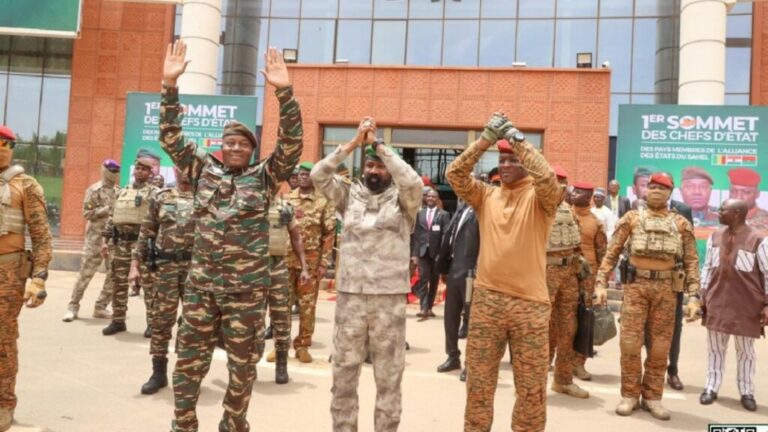
Two years after its formation, the Alliance of Sahel States (AES) is showcasing significant institutional growth with ambitious projects, even as it continues to grapple with major security, economic, and political hurdles.
The alliance’s progress comes as the military regimes in its member countries have extended their mandates, raising questions about the future of civilian rule.
The AES, founded on September 16, 2023, by Mali, Niger, and Burkina Faso, began as a defensive alliance through the Liptako-Gourma Charter. It emerged during a diplomatic crisis following a coup in Niger and amid intervention threats from the Economic Community of West African States (ECOWAS). The AES’s final break from ECOWAS was formalized on January 29, 2025.
In a move toward deeper integration, the alliance was transformed into the Confederation of Sahel States in July 2024, expanding its scope to include political, economic, and cultural cooperation. With Malian head of state General Assimi Goita as its current president, the confederation has since established several new institutions, including a confederal radio station and an official anthem. A Confederal Bank for Investment and Development (BCID-AES) is planned, along with a regional Criminal and Human Rights Court and a confederal parliament. However, funding for these ambitious projects remains a key challenge, as the entire system heavily relies on national resources.
Security progress amidst persistent threats
On the military front, the AES nations have reported successes, but a significant security threat remains. Burkina Faso authorities claim to have reclaimed control of 72.70% of their territory by June 2025. In Mali, the army reported repelling multiple coordinated jihadist attacks in July, neutralizing over 80 assailants and capturing a key Islamic State leader.
Despite these victories, the region continues to be the global epicenter of terrorism. According to the Global Terrorism Index from March 2025, deaths from jihadist violence in Niger surged by 94% in 2024, reaching 930 victims. The Sahel as a whole accounted for 51% of all terrorism-related deaths worldwide in the same year, with Burkina Faso remaining the most affected country.
Evolving alliances and international relations
The AES’s creation and subsequent actions have reshaped diplomatic dynamics in the region. The relationship between the three member states and France has significantly deteriorated, leading to an increase in Russia’s influence. Meanwhile, other international players, including the United States, are seeking to re-establish their presence.
Notably, Morocco is emerging as a more prominent regional actor through its “Atlantic Initiative,” which aims to open up the Sahel and improve economic connectivity. Morocco’s diplomatic and security cooperation, which has led to the release of foreign nationals and helped secure Moroccan drivers in Burkina Faso, is also strengthening its role in the region.
AC/Sf/fss/abj/APA