





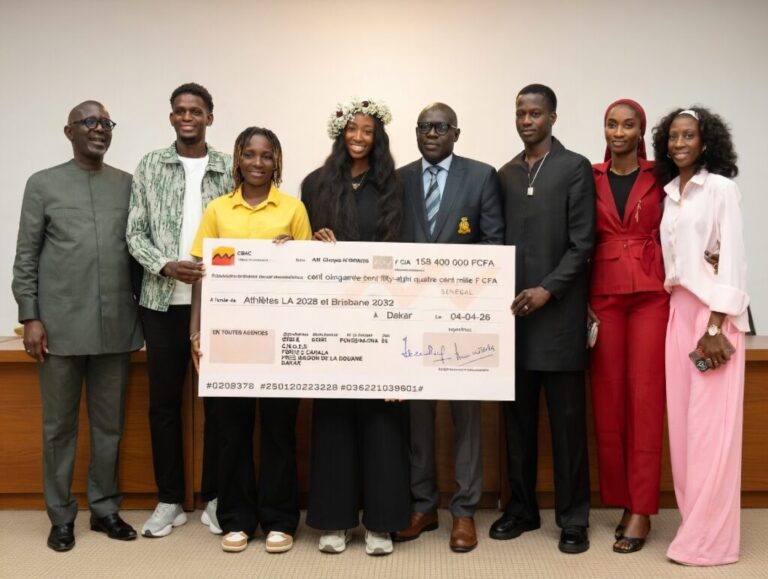
Senegal’s National Olympic and Sports Committee (CNOS) and the government have committed more than CFA500 million to support athlete preparation for the Los Angeles 2028 and Brisbane 2032 Olympic Games.
This is through a scheme combining individual scholarships, logistical support, and medical assistance.
A total of nearly CFA535 million has been mobilised through two complementary mechanisms led by the CNOS and the Ministry of Sports, with the aim of strengthening the preparation and competitiveness of Senegalese athletes.
The CNOS has awarded scholarships to 20 athletes across various disciplines, with a total envelope estimated at CFA300 million.
“We have granted scholarships to 20 athletes from different sports. Ten are preparing for the Los Angeles 2028 Games, and the other ten are targeting Brisbane 2032,” said CNOS Secretary-General Seydina Oumar Diagne.
Athletes aiming for Los Angeles will each receive CFA17 million through July 2028, while younger athletes preparing for 2032 will benefit from approximately CFA7.6 million each over the same period.
Beyond the financial aspect, the initiative carries strategic importance. “These scholarships enable athletes to train, travel, and above all compete internationally,” Diagne explained, stressing the need to “accumulate ranking points, particularly in disciplines such as taekwondo and judo,” to improve global standings.
Team sports are also included. A budget of CFA55 million has been allocated to the women’s national volleyball team. “If they qualify for Los Angeles 2028, they will receive CFA100 million to better prepare for the final phase,” he added.
In parallel, the Senegalese government, through the Ministry of Sports, plans to fund 15 athletes with a budget of CFA235 million, according to the Director of High-Performance Sport, Cheikh Tahirou Fall.
This program includes a monthly scholarship of CFA200,000 per athlete, along with comprehensive support. “They will benefit from medical care, equipment, air transport, accommodation, and meals,” he said, noting that the objective is to enable them to “participate in competitions, training camps, and preparation under optimal conditions.”
Authorities have, however, adopted a gradual approach. “This is a pilot year, which is why we have limited the program to 15 athletes in order to evaluate it in 2027,” Fall explained.
Beyond the figures, sports officials highlighted the symbolic and strategic significance of the investment.
“The scholarship you receive today is not a gift; it is recognition of your past efforts and a driver for your future ambitions,” said CNOS Vice-President Mamadou Ba.
Emphasising the demands of elite sport, he reminded beneficiaries that “sport requires immense sacrifice” and that “your main opponent is yourself.”
He added that these funds should help athletes “turn pressure into performance and proudly represent Senegal.”
In this context, beneficiaries are also expected to play a role beyond competition. “You are becoming ambassadors of Senegalese sport,” he said, urging them to “set an example both in their sporting careers and in their academic paths.”
Through this dual financing mechanism, Senegal aims to sustainably structure its elite sports system and improve its performance in upcoming international competitions, with a clear focus on the 2028 and 2032 Olympic Games.
ARD/ac/Sf/lb/as/APA