





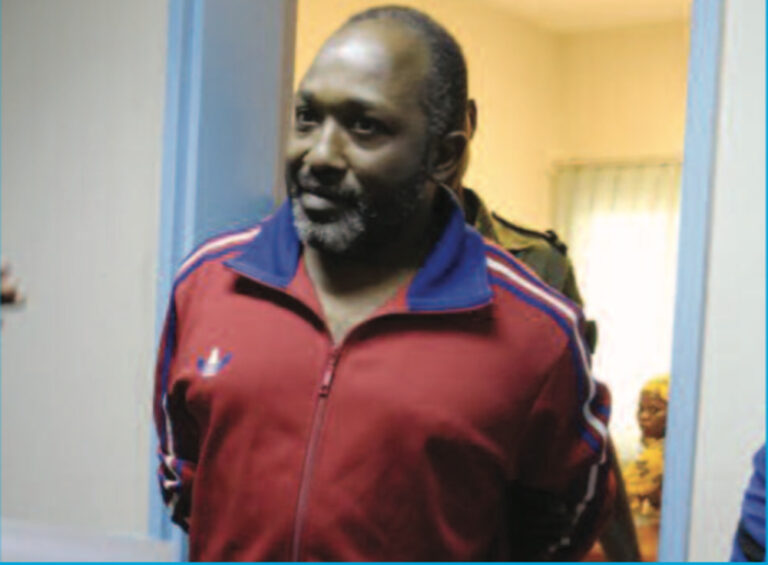
Doctor, ranger, aide-de-camp, accused of crimes against humanity, high-profile inmate: Aboubacar Sidiki Diakité, known as Toumba, who died on Wednesday at the military hospital in Conakry, remained until the end a man whose destiny defied all expectations.
He began his life treating heart diseases. He ended it under the scalpels of fellow doctors, alone in a military hospital, far from his family. According to Guinean authorities, Toumba died at 04:35 a.m. at the Samory Touré military camp hospital from a strangulated hernia of the linea alba complicated by generalised acute peritonitis. He was 57.
Born on 30 April 1968 in Conakry, Diakité studied medicine in Guinea and worked for seven years as a resident doctor in cardiology at the Ignace Deen University Hospital. A professor there reportedly encouraged him to join the army, seeing in him a natural authority that hospital corridors could not contain.
He enlisted in 1993, trained as a ranger with American instructors, and served as a garrison chief medical officer in Kankan and Soronkoni. He gained field experience in conflict zones along the Liberian border. At that stage, the soldier remained a healer. Nothing yet foreshadowed what would follow.
Everything changed on the night of 22 December 2008. Following the death of President Lansana Conté, Toumba claimed to have personally helped Captain Moussa Dadis Camara seize power, outmanoeuvering General Mamadouba Toto Camara. He became aide-de-camp to the new head of state — a shadow figure and enforcer within a regime that soon descended into violence.
On 28 September 2009, he was at Conakry’s stadium. That day, more than 150 people were killed and dozens of women raped during an opposition rally. Years later, prosecutors identified him as a key architect of the repression. He maintained he had only gone there to protect political leaders.
Three months later, on 3 December 2009, he shot President Dadis Camara, accusing him of attempting to shift sole responsibility for the massacre onto him, before fleeing to Senegal. He lived in hiding until his arrest in Dakar on 16 December 2016 and his extradition to Guinea on 13 March 2017.
When his trial opened in 2022, it gave him an unexpected platform. Appearing before the Dixinn criminal court in October 2022, the man once labeled “Lucifer incarnate” revealed himself articulate and composed, quoting Quranic verses and methodically challenging the charges against him.
“His name already inspired fear, terror. So he had to prove to people that he was human,” said his lawyer, Me Paul Yomba Kourouma. His performance irritated co-defendants but swayed part of public opinion: by late 2022, still behind bars, he was voted personality of the year by a private Guinean media outlet.
Sentenced in July 2024 to ten years in prison for crimes against humanity, he remained defiant. From his cell, he founded the Democratic Party for Change and declared his candidacy for the December 2025 presidential election, before the Supreme Court rejected his bid.
In February 2026, a prison search uncovered mobile phones, psychotropic substances, and bladed weapons in his possession. He was transferred to Coyah prison on 10 February.
His health deteriorated rapidly. A medical report dated 4 March 2026 from specialists at Ignace Deen hospital — where he had once trained — noted abdominal pain, chronic constipation, and sleep disorders. On the night of 23 March, a sudden collapse led to his emergency transfer to the military hospital.
His family, kept away since his transfer, issued a request for proof of life later that Wednesday. It came too late.
Toumba Diakité is the second major figure convicted in the 28 September trial to die in custody, after Colonel Claude Pivi, sentenced to life imprisonment, who died in January 2026. With him disappears one of the last direct witnesses to a national tragedy whose wounds from which Guinea has yet to fully heal.
AC/Sf/lb/as/APA