



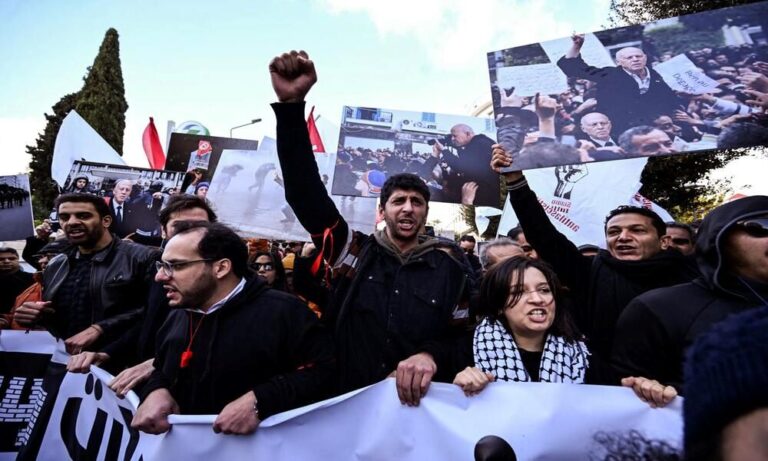
Tunisian authorities have initiated legal proceedings against Chawki Tabib and Sihem Bensedrine, two prominent figures in civil society who emerged during the democratic transition, according to multiple sources.
Chawki Tabib, the former president of the bar association and former head of the Tunisian National Anti-Corruption Authority (INLUCC), has been detained and is facing legal proceedings. Sihem Bensedrine, the former head of the Truth and Dignity Commission, is also facing legal proceedings.
These developments are taking place within the context of institutional restructuring that began in 2021. Continuing this trend, Chawki Tabib sent a letter from his detention in Mornaguia prison, in
which he states that he remains “calm and confident,” while denouncing a violation of fundamental legal principles.
He specifically mentions “the right to a fair defense, the independence of the judiciary, and
the guarantees of a fair trial,” arguing that the proceedings go beyond his personal case and strike at the very foundations of the legal profession.
This case is part of a broader trend marked by the gradual erosion of the institutions established after the 2011 revolution.
Chawki Tabib, who headed the INLUCC (National Anti-Corruption Authority) between 2016 and 2020, embodied one of the main mechanisms for combating corruption.
His removal in 2020, followed by the political decisions made from 2021 onward, has progressively redefined the balance between the executive, judicial, and independent bodies.
In this context, the prosecution of Sihem Bensedrine, who is associated with the transitional justice process, reinforces the perception of a targeting of the former checks and balances.
Several observers believe these proceedings are part of a broader movement toward the recentralisation of power, in which emblematic figures from the post-Ben Ali era appear particularly vulnerable.
Beyond individual cases, these developments fuel questions about the evolution of the rule of law in Tunisia.
For their part, the authorities defend a strict application of the law and a commitment to institutional reform, while critics emphasize the implications of these prosecutions for judicial independence and the sustainability of democratic gains.
MK/AK/Sf/fss/as/APA