





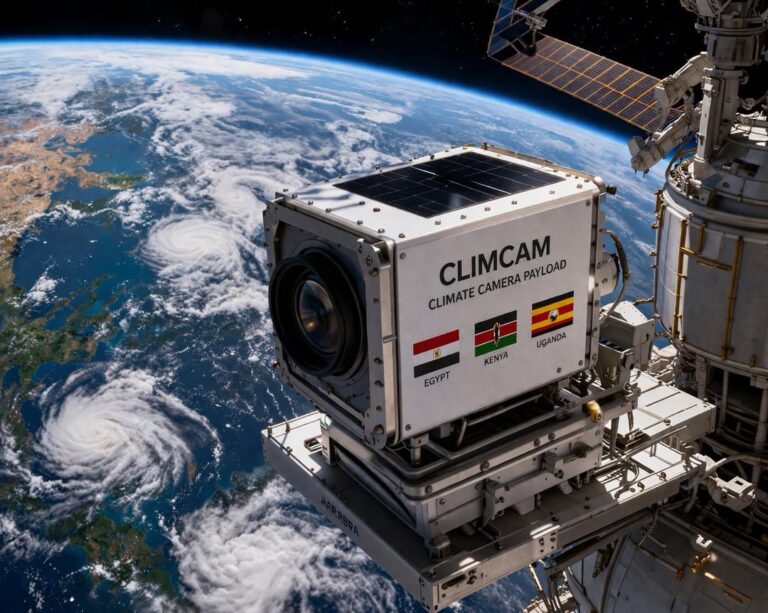
Uganda will launch its first space-based climate monitoring camera on Friday, April 10, to improve early warnings for floods, drought, and changing weather patterns across the country, authorities announced on Thursday.
The camera, known as ClimCam, has been sent to the International Space Station aboard and will begin sending back data later this year.
This is a joint project between Uganda, Kenya, and Egypt, supported by the United Nations Office for Outer Space Affairs and Airbus
“It was supposed to be launched on April 8, but because of some weather conditions, It will be launched tomorrow, (April 10), and it is going to be taken to the International Space Station, where we expect it to be commissioned in August,” Monica Musenero, minister for science, technology and innovation, said as she opened the National Science Week at Serena Hotel on Thursday (April 9).
Once operational, the camera will pass over East Africa up to four times a day, capturing detailed images that can help scientists and governments detect risks earlier.
“Once commissioned, this camera is going to pass over East Africa four times every 24 hours and is going to be able to collect real-time data which we will be able to download at our POMA station and that will help us manage not just the climate but also the associated scares like what we had in Kiteezi, and this will help us to prevent disasters,” she added.
Uganda has in recent years faced increasing climate shocks, including floods and prolonged dry spells that have affected farming, destroyed homes, and displaced communities.
“This technology will help us see floods before they happen and track drought as it develops. The data collected will also support agriculture by helping farmers better understand weather patterns and plan planting seasons,” she said in a visual statement
“It shows that Uganda is building its own scientific capacity, Musenero added.
For years, Uganda has depended on foreign satellite data to monitor weather and climate. With ClimCam, the country will now have more direct access to information about its own environment.
Musenero said this will improve decision-making in disaster response, farming, and environmental protection, and also believes it will not only help the country respond better to climate change but also position it as an emerging player in space technology in the region.
MG/as/APA