



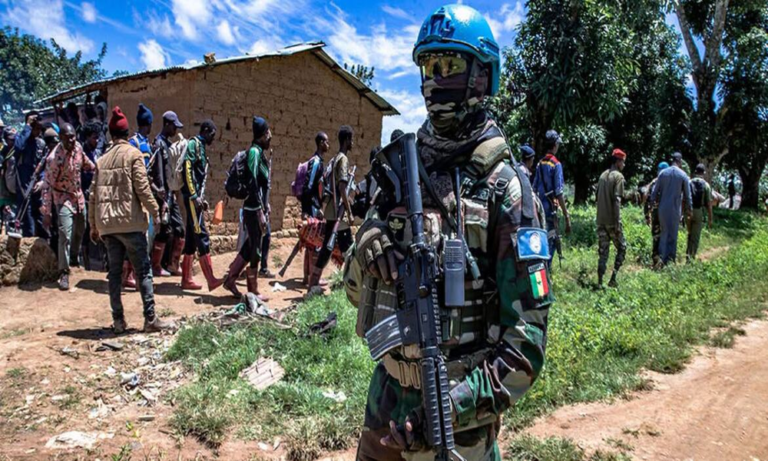
The United Nations Security Council unanimously adopted a resolution extending the mandate of United Nations Multidimensional Integrated Stabilization Mission in the Central African Republic (MINUSCA) – deployed since 2014 – until November 15, 2027.
The text provides for a reduction in the authorized military troop ceiling, lowering it from 14,046 to 12,000 soldiers, while initiating a gradual transition of responsibilities to national institutions.
This extension includes a reduction in the authorised military troop ceiling and sets the stage for a phased transfer of responsibilities to Central African authorities – a process taking place against a backdrop of persistent security fragility, exacerbated in particular by the repercussions of the war
in Sudan.
This decision comes after twelve years of the UN mission’s presence in a country that has made progress on the political and security fronts, yet continues to experience violence in several regions, notably in the north and east.
The resolution, introduced by France, also maintains the authorised caps of 2,265 police personnel and 40 corrections officers. However, the reduction in the authorized military troop ceiling does not imply an immediate withdrawal; MINUSCA currently has approximately 10,000 military personnel on the ground.
The UN notes progress in the disarmament and demobilization process for armed groups. Of the fourteen groups that signed the 2019 peace agreement, eleven have been dissolved, disarmed, and demobilised, while two others are currently engaged in the process. More than 1,900 combatants have laid down their arms since July 2025.
However, the economic reintegration of former combatants remains a challenge, while insecurity persists around mining sites and transhumance corridors.
The situation is further exacerbated by the repercussions of the conflict in Sudan. The Security Council has specifically condemned incursions by the Rapid Support Forces (RSF) into Central African territory, as well as their collaboration with local armed groups.
The attack that took place on June 30 in Am Dafock, near the Sudanese border, illustrates this security fragility. According to the latest report from the UN Secretary-General, the fighting resulted in 29 deaths – including seven civilians – and the displacement of approximately 17,500 people. Six peacekeepers were also wounded during an attack on a MINUSCA base.
In light of these threats, the mission must concentrate its resources in the most vulnerable areas and ensure that the transfer of its responsibilities is contingent upon the actual capacity of Central
African institutions.
Authorities in Bangui have warned against a premature withdrawal, arguing that a more targeted international presence should not mean abandoning populations that remain exposed to violence.
For their part, the United States supported the renewal of the mandate, welcoming in particular the reduction in the authorised military troop ceiling and the removal of electoral tasks from the
mission’s remit.
Beyond security concerns, the humanitarian situation remains worrying.
Nearly two million Central Africans – 31% of the population – faced acute food insecurity between April and August. As of early October, the United Nations humanitarian plan was less than 50% funded. The resolution sets no deadline for the final withdrawal of MINUSCA. The timeline for this transition will depend on how the security situation evolves and on the Central African state’s capacity to ensure the long-term protection of its population.
Deployed to the Central African Republic in 2014 – following the 2013 ouster of President François Bozize and the violence between the Seleka and anti-Balaka armed groups – MINUSCA’s mission is to protect civilians, support the peace process, and assist in the restoration of state authority. Its mandate is regularly renewed by the UN Security Council.
After twelve years of intervention, the mission is now entering a new phase, focused on the gradual reduction of its presence and the transfer of its responsibilities to national authorities.
DM/Sf/fss/as/APA