





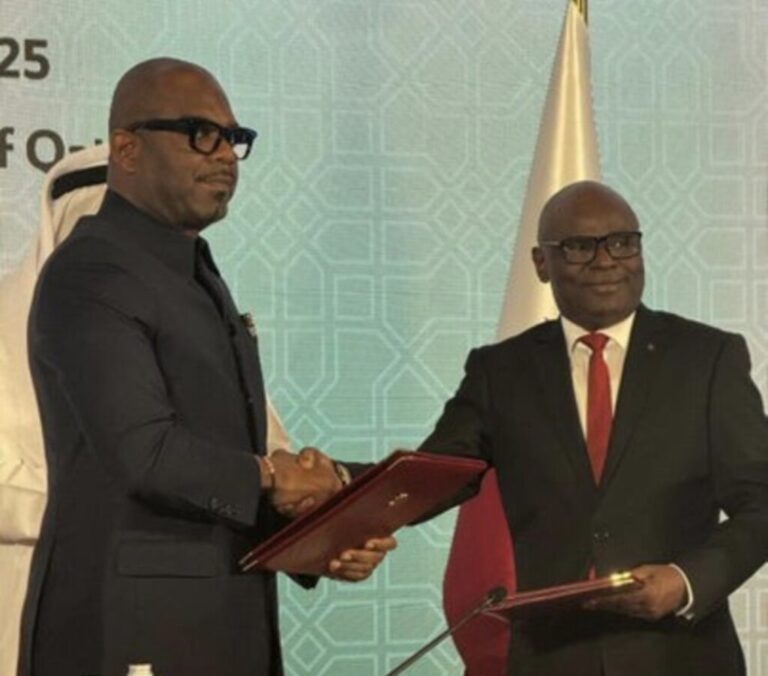
US officials have warmly welcomed the Declaration of Principles signed Saturday in Doha, Qatar, between the Democratic Republic of Congo (DRC) government and the Congo River Alliance/March 23 Movement (AFC/M23).
This agreement establishes a permanent ceasefire and mandates the opening of direct negotiations for a comprehensive peace agreement by August 18, 2025. The United States views this as a direct continuation of the DRC-Rwanda agreement signed in June in Washington.
“The United States welcomes the signing of this Declaration of Principles between the government of the Democratic Republic of the Congo (DRC) and representatives of the Congo Rivers Alliance/March 23 Movement,” stated Tammy Bruce, a spokesperson for the U.S. State Department. In a note to APA, she described it as a “significant step toward advancing lasting peace and stability in the Great Lakes region.” Washington specifically lauded Qatar’s pivotal role in facilitating this breakthrough. “We express our sincere gratitude to the State of Qatar for its critical role in facilitating this process. Qatar’s leadership and dedication to fostering dialogue between the DRC and the M23 have been instrumental in supporting a peaceful resolution of the conflict,” the spokesperson emphasized.
Agreement builds on Washington’s initiative
The U.S. State Department has positioned this Doha Declaration of Principles as a direct follow-up to the peace agreement signed between the DRC and Rwanda on June 27 in Washington, D.C., which was negotiated under U.S. auspices. The Doha accord further stipulates that direct negotiations for a comprehensive peace agreement must be concluded no later than August 18, 2025, maintaining consistency with the June 27 Washington agreement.
The United States encourages all parties to “respect their commitments under the Declaration of Principles and to continue the discussions necessary to reach a comprehensive peace agreement.” Washington reaffirmed its commitment to “driving progress toward peace in eastern DRC that results in the restoration of DRC authority and and inclusive governance.”
Broad international support for the initiative
The United Nations Stabilization Mission in the Democratic Republic of the Congo (MONUSCO) also praised the agreement, calling it “essential on the path to lasting peace,” according to a statement received by APA. MONUSCO urged the parties to uphold their commitments, including the ceasefire, civilian protection, and the voluntary return of displaced persons. The UN body reaffirmed its readiness to support the cessation of hostilities and establish a credible verification mechanism, pushing signatories to “act in good faith at every stage of the process” and “prioritize the aspirations of the Congolese people.”
Rwanda, for its part, welcomed the agreement as “a significant step towards the peaceful resolution of the conflict” in eastern DRC. Kigali highlighted that the text addresses the root causes of instability while aiming to restore security. Rwanda paid tribute to Qatar’s mediation, “supported by the United States, the African Union, and joint initiatives of the East African Community (EAC) and SADC,” reaffirming its commitment to regional peace and economic development.
Seven core commitments
Signed by Samba Sita Mambo, representing the Congolese President, and Benjamin Mbonimpa, Permanent Secretary of the AFC/M23, the document outlines seven main components. The parties commit to resolving their differences peacefully, rejecting hostile rhetoric, and reaffirming the territorial integrity of the DRC.
The agreement mandates a permanent ceasefire, including an end to attacks, hate speech, and attempts to seize new positions, all under the supervision of a monitoring and verification mechanism. Confidence-building measures, such as the release of prisoners of interest through an ICRC-facilitated mechanism, are also included. The full restoration of state authority throughout the territory is cited as a logical consequence of a peace agreement, with parties committing to facilitate the safe and dignified return of displaced persons and refugees in accordance with international humanitarian law.
This Declaration marks a new, critical phase in the ongoing regional and international efforts to pacify eastern DRC, a region plagued by decades of armed violence, with the United States playing a key facilitating role in this diplomatic process.
AC/Sf/fss/abj/APA