





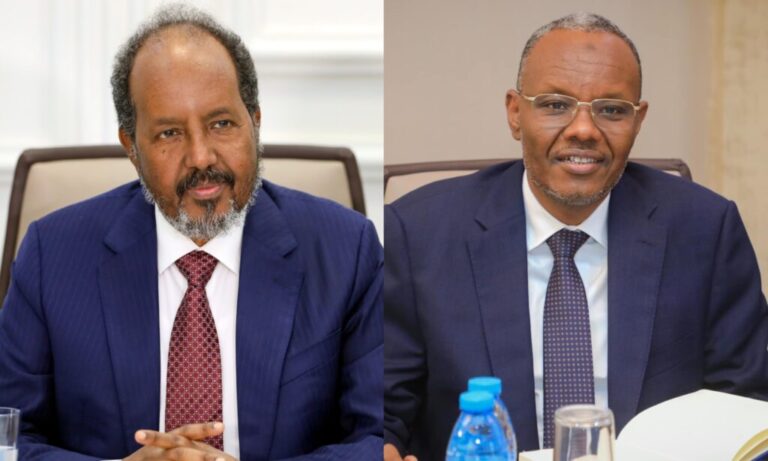
Somalia appears to be hurtling slowly towards another political and constitutional crisis between the federal government in Mogadishu and the authorities in its autonmous regions.
The latest rift is with the Southwest State administration led by the freshly re-elected Abdiaziz Laftagaren Mohamed whose state administration is not recognised by officials in Mogadishu who have sent troops to remove him, taking the country on a dangerous precipice for armed confrontation.
The crisis has deepened to such an extent that the chairperson of the African Union (AU) Commission Mahmoud Ali Youssouf has weighed in, expressing concern that the impasse may lead to military hostlilies between federal forces and the state’s security forces.
The AU scribe referred to the National Consultative Council as an important framework for inclusive dialogue and consensus-building and encouraged all Somali stakeholders to make constructive use of this platform to resolve differences peacefully.
So far that call is falling on deaf ears as the authorities in the Southwest State stick to their guns even as federal forces are ordered to occupy the capital Baidoa and restore federal sovereignty over state institutions there.
In recent years, Somalia has been in the throes of a political quagmire with its regions most notably Puntland which in 2024 decried a bid by Mogadishu to curtail its constititional powers by centralising constitutional changes which are still hotly contested. This led to a strain in relations reminiscent of a similar rift with Jubaland over the re-election of regional officials. The regions constantly accuse the federal authorities of chipping away at their regional autonomy by unwarranted interference in the running of their administrations.
The Somali parliament earlier in March voted unanimously for a new constitition to replace the provisional blueprint from 2012. The new constitution extends the presidential term from the current four years to five years and stipulates that the president will be elected by parliament, while MPs will be chosen directly by citizens, an unprecedented constitutional development in the history of Somali elections.
But challenges of the old status quo remain in relation to where federal powers end and the authority of the autonomous regions begins.
The lack of clear constitutional boundaries has not helped relations between Mogadishu and its autonomous regions. The blurred lines of federal and state authority have been the catalyst for regular political disputations and legal wrangling over jurisdiction and observers say the contents of the new constitution are not likely to allay such mutual distrusts in the immediate and long term.
While regional authorities say federal officials have been trying to dictate local politics from Villa Somalia in Mogadishu, the federal government feel the assertiveness of its states undermines the unity of Somalia as a federation. There is an unspoken federal resolve to preemept a repeat of a complete breakway from the federation such as was witnessed in 1991. Somalia still lay some hollow claim to Somaliland as its sovereign enclave more than thirty years after the region declared its independence from the rest of the federation. There was shock and consternation in Mogadishu as Israel declared its full recognition of the renegade province as a sovereign independent republic. The only source of solace for Mogdishu is the rest of the international community holding on to its policy of regarding the region as part of Somalia.
In its quest to reverse this scenario by trying to build a stronger, centralised federation, Mogadishu is set on a natural collision course with its autonmous states which are demanding greater autonomy. Puntland in 2024 nearly followed Somaliland’s example by declaring near-total independence from Somali federal institutions.
This was seen as on-the-spur posturing from Puntland more than a definitive, studied and deliberate state policy direction or solid ambition to break free from the federation. Two years later talk of Puntland secession rings hollow if it exists although relations with President Hassan Sheikh Mohamud are still muddled.
Writing a paper for Good Governance Africa (GGA), Dr Dereje Tesema, and Dr Zerehum Mohammed captured the extent of the mistrust between federal and state officials in Somalia.
They said the federal government which is tied to introducing universal suffrage to replace the indirect, clan-based voting system in national and regional elections later this year, met with spirited opposition from the president of Jubaland region, Ahmed Mohamed Islam (Madobe) who criticised the scheme as risking more and more centralisation at the expense of regional autonomy.
Abdiaziz Laftagaren Mohamed, the president of Southwest State since 2018 has been at daggers drawn with Mogadishu who refused to recognise his re-election over the weekend, arguing that his term in office had ended in 2023 and he had no authority to prolong it by another election. Abdiaziz, who served as federal government minister rejects the new constitition on the basis that it curtails some of the autonomy of the states making up the federation. He speaks more in favour of the 2012 provisional constitution with all its latent flaws, and insisted that his administration cannot be replaced by one called from Mogadishu. In his opinion that would be open direct encroachment on the autonomy of the state. Abdiaziz has since given up his role as deputy chairman of President Mohamud’s Justice and Solidarity Party (JSP), underlining the deepening rift with Mogadishu. To enforce Mogadishu’s authority, thousands of federal troops including special forces have been deployed to Burhakabo with instructions to reach the SouthWest State capital, Baidoa and eject Abdiaziz and his administration.
The AU wary of the unsettling prospect of fresh security challenges to the one its hybrid peacekeeping force is facing against the mlitant group al-Shabaab, is calling for restraints from both sides.
AUC chairperson Youssouf believes that the differences between Mogadishu and regional states should be addressed through dialogue guided by the spirit of unity to preserve Somalia’s stability and security.
The civil strife which continued after the overthrow of Siad Barre in the early 1990s still threatens to disintegrate Somalia where shifting power dynamics are dictating the country’s precarious future.
MG/as/APA