



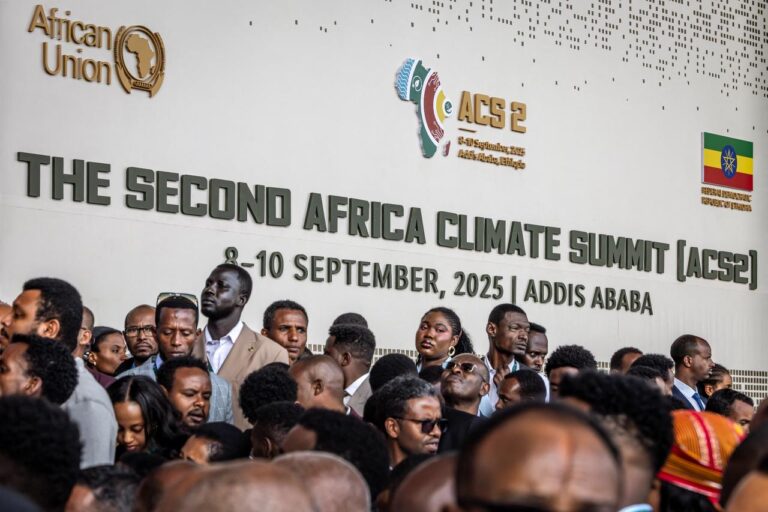
Addis Ababa is hosting the second African Climate Summit (ACS2) from September 8 to 10, 2025, a crucial gathering aimed at transforming the continent’s climate ambitions into concrete action.
Two years after Nairobi set the tone at the first African Climate Summit (ACS), Africa is meeting again in the Ethiopian capital under the ambitious theme: “Accelerating Global Climate Solutions: Financing Africa’s Green and Resilient Development.”
More than 45 heads of state are attending this edition, which organisers say will be “marked by determination rather than rhetoric.”
At the heart of the debates is Africa’s major goal of boosting renewable energy capacity from 56 GW in 2022 to at least 300 GW by 2030. It is a colossal challenge for a continent that holds 60% of the world’s solar potential and 39% of total global renewable potential, yet receives only 2% of global investment in the sector.
“As we gather for ACS2, our mission is clear: to transform the ambition of 2023 into action by scaling up capital, unlocking value chains and forging alliances that anchor Africa’s competitiveness in the global green economy,” said Ali Mohamed, climate envoy of Kenyan President William Ruto.
The stakes are high. According to the International Energy Agency, Africa could quadruple the size of its economy by 2040 while consuming only 50% more energy if it harnesses its vast clean energy resources. A transition to 100% renewables could create 2.2 million additional jobs in the energy sector.
Adaptation: An economic survival imperative amid massive financing gap
Africa, which accounts for less than 4% of global greenhouse gas emissions but suffers some of the heaviest climate impacts, continues to lose 5% of its GDP to adaptation measures. In response, the continent is calling for a radical transformation of financing mechanisms.
Preparatory documents for the summit indicate that Africa needs about $579 billion for adaptation between 2020 and 2030. Yet current adaptation flows are five to ten times below actual needs.
According to Emmanuel Seck, Executive Director of Enda Energie, this shortfall stems from the “failure” of Africa’s institutional architecture, with too few countries possessing accredited entities with international funds or operational national mechanisms to capture financing. “This structural weakness deprives the continent of direct access to available climate resources,” he noted.
More troubling, Seck denounces widespread double-counting, where climate funds are integrated into allocations for education, health or agriculture, distorting commitments and undermining transparency. “This accounting confusion masks the fact that climate finance pledges do not always represent new, additional resources,” he explains.
Seck calls for a conceptual revolution, shifting from a development-aid mindset to one of strategic investment. “This approach requires clarity in financial flows and rigorous tracking of resources genuinely allocated to climate action, particularly as COP30 approaches,” he said.
The challenge is not only about amounts. Seck insists on the need for “localised climate governance” through decentralised systems that address the concrete needs of communities. He advocates a “localised climate fund” with regional windows directly accessible to farmers, herders and fishers to finance adaptation activities linked to local realities.
Climate debt is another pressing concern. Seck argues it is “unacceptable, from the standpoint of climate justice, for the most vulnerable countries to be forced into debt to confront a crisis they did not cause.”
Adrian Chikowore of Christian Aid Zimbabwe agrees, saying: “Africa cannot fight the climate crisis while drowning in debt. Public finance must be restored to its proper role, ensuring that climate action is funded through fair, predictable instruments that do not generate debt.”
Former Mauritian President Ameenah Gurib-Fakim stressed that “debt reform can no longer be dissociated from climate reality. For Africa and the entire Global South, climate change is an existential threat, even as these regions provide ecosystem services that sustain life worldwide.”
“African nations with natural carbon sinks must be fairly compensated, without geographic discrimination. The continent cannot continue to be marginalised in carbon compensation schemes while actively contributing to global climate balance,” says Mbaye Hadj, an energy resources engineer and member of NGO Legs Africa.
For him, the real battle is gaining recognition of Africa’s rights in international climate finance. “Beyond generic calls for climate justice, the continent must assert itself as a legitimate, demanding actor in global environmental governance,” he urges.
This concern was forcefully raised by former Senegalese President Macky Sall at the first summit and, according to Seck, deserves to be pursued “with greater vigour” by African leaders.
The international financial architecture itself has come under deep criticism. Seck notes that over 60% of Green Climate Fund resources are managed by five major international institutions, often outside developing countries. He calls for decentralisation of mobilisation capacities, prioritisation of African institutions, and retention of administrative costs within beneficiary countries rather than donor nations.
Mbaye Hadj adds a geopolitical dimension, denouncing persistent “mistrust” toward African nations in accessing climate funds, which he interprets as a “deliberate unwillingness to fully support them.” He also highlights the gap between repeated international pledges since Copenhagen, reaffirmed in Paris and Glasgow, and their limited realisation on the ground.
The energy expert also warns of a strategic risk: the obsolescence of Africa’s climate benchmarks. He observes that African adaptation plans still align with the Paris Agreement’s 1.5°C and 2°C goals, “thresholds on the verge of being breached.” This mismatch, he argues, could render current adaptation strategies and budgets ineffective.
In response, Hadj calls for a complete revision of reference scenarios, rigorous assessment of projected impacts, and the drafting of “realistic and ambitious” budgets. “Continuing to plan on the basis of thresholds already exceeded is like building levees against a sea that is already in flood,” he says.
For his part, Dr. Nnimmo Bassey, Executive Director of Nigeria’s Health of Mother Earth Foundation, urges “real climate action, a drastic reduction in emissions, an end to neo-colonial land grabs, respect for indigenous wisdom on living within planetary limits, payment of climate debt and an end to ecocide.”
Mohamed Adow of Power Shift Africa in Kenya goes further, arguing that for ACS2 to succeed, it must renew Africa’s climate and development vision. More importantly, he says, the summit should tackle the continent’s core challenges: hunger, poverty, conflict, debt, energy insecurity and inadequate infrastructure.
Local solutions to scale up
Interviews reveal concrete solutions already in place that should be highlighted at ACS2. Among them, Seck cites several promising initiatives in Senegal: the coastal erosion adaptation project in vulnerable areas funded by the Adaptation Fund, the Clean Cooking program led with GIZ that distributed hundreds of thousands of improved stoves, and land restoration projects in the Saloum Delta.
He also mentions innovations in sylvo-pastoral areas where his organisation installed solar-powered cooling units to process milk into pasteurized products and yogurt. “If scaled up nationally, these innovations could significantly boost rural communities’ economic resilience,” he says.
Beyond tailoring solutions to African realities, Patricia Odeibea Bekoe of the Odeibea Foundation in Ghana stresses the importance of inclusion to ensure the summit’s success.
“I hope decisions will go beyond high-level pledges to deliver tangible, inclusive outcomes that directly address the needs of African communities on the climate frontlines, so that women and youth are not merely seen as beneficiaries but as full partners in finding solutions,” she points out.
Thato Gabaitse of We The World Botswana echoes the view: “This summit should demonstrate that Africa speaks with one voice, defining its own agenda, climate action and sustainable development for all. It is our chance to present unified positions on climate finance, technology transfer and just transition pathways ahead of COP30 negotiations.”
Leaders determined to shift paradigm
African leaders’ commitment is evident in their statements. Ethiopian Prime Minister Abiy Ahmed, host of the summit, declares: “The time for talk is over. What is needed is bold action. We are not victims of a crisis we did not create but architects of a just, green and resilient future. Africa seeks not charity, but justice; not pity, but partnership.”
Ethiopian Planning and Development Minister Fitsum Assefa highlights the continent’s potential, noting that Africa has the opportunity to build resilient, sustainable economies from the ground up, reducing the risks of green investment and increasing long-term returns.
“To unlock this potential, outdated perceptions of Africa as a high-risk continent must be abandoned, and its central role in global climate stability and economic equity must be recognized,” she adds.
Toward the Addis Ababa Declaration
The summit is set to culminate on September 10 with the Addis Ababa Declaration, expected to “send a clear signal: resilience is not just protection against losses but a smart economic investment that improves livelihoods and fosters long-term growth.”
The declaration is seen as a crucial prelude to COP30 negotiations, with the ambition of charting a roadmap “from Baku to Addis Ababa, via Belém.” Africa aims to deliver a unified message to the world: “We are partners shaping the planet’s future.”
As South African climate expert Bhekumuzi Dean Bhebhe sums it up: “The African Climate Summit in Ethiopia must be a moment of clarity, not capitulation. Leaders have the chance to establish a common stance to demand a financial architecture rooted in dignity and distributive justice.”
ACS2 is thus shaping up to be a decisive turning point in Africa’s quest for a just and equitable climate transition, with the ambition of moving “from declarations to action” and finally gaining recognition as a major player in global climate solutions.
ARD/ac/sf/lb/as/APA