





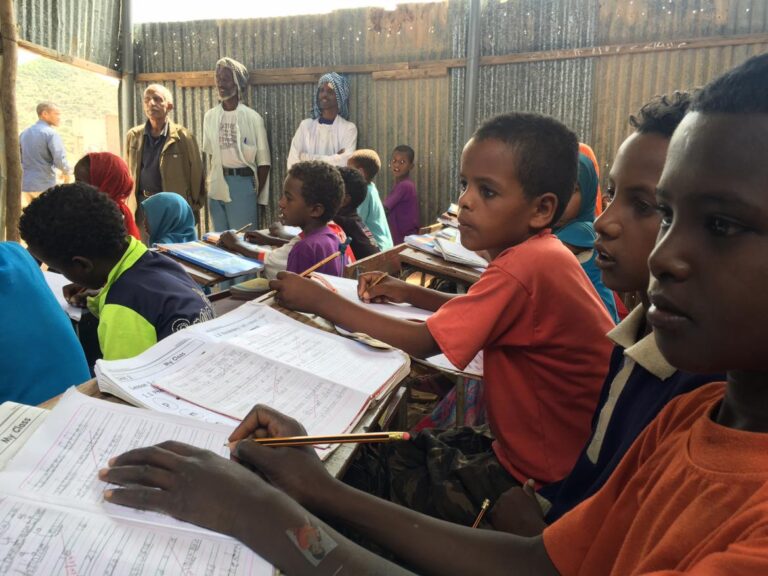
African Union (AU) called on its member states to promptly address the foundational learning challenges in their respective countries.
The call came at the validation workshop being held at the African Union (AU) headquarters in Addis Ababa, the capital of Ethiopia, to end Learning Poverty in Africa.
Data from the AU shows that approximately 9 out of 10 children in sub-Saharan Africa are unable to read proficiently by age 10.
InSeptember 2024, the AU launched the End Learning Poverty for All in Africa (ELPAf) campaign as a flagship initiative while it marked the AU Year of Education.
The campaign aims to increase the number of children who can read, write, and perform basic math by age 10. It seeks to ensure that every child in Africa achieves quality foundational literacy and numeracy (FLN) skills by 2035.
Accordingly, Zambia and Malawi recently launched a campaign to address the continent’s foundational learning challenges.
On Tuesday the African Union began a validation workshop on the FLN practice to end learning poverty in Africa, bringing participants from across the continent to its headquarters in Addis Ababa.
During the event, Professor Saidou Madougou, the Director of the Department of Education, Science, Technology, and Innovation at the African Union, underscored the critical necessity to tackle learning poverty in Africa.
He pointed out the significant effects of educational poverty, which extend beyond an educational crisis and greatly influence the social development of African nations.
He further stated that these obstacles hinder children from achieving their full potential and jeopardize the future of society, as education serves as the foundation for socio-economic advancement.
Consequently, the director urged for a reversal of this detrimental trend through a revitalized fundamental education system that acknowledges essential numeracy and literacy skills in primary education.
Additionally, he called upon member states of the African Union to exchange practical experiences and enhance collaboration among stakeholders in combating learning poverty.
MG/abj/APA