





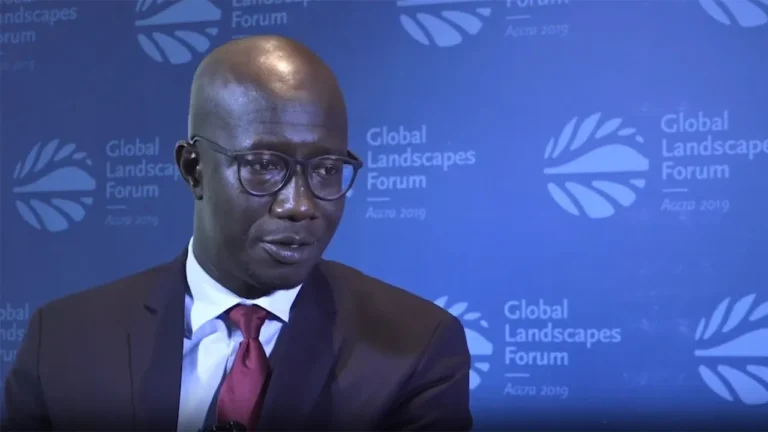
Ahead of the African Food Systems Forum (AFSF) set for September in the Senegalese capital Dakar, Director General Amath Pathe Sene outlines the event’s key goals, namely unlocking investment for young agripreneurs, scaling up models like community agricultural cooperatives, and turning the climate emergency into real action.
The aim: building sovereign, resilient, and inclusive food systems across Africa.
AFSF 2025 places African youth at the heart of food systems transformation. Concretely, what youth-driven innovations and solutions will be showcased at the forum, and how do you plan to ensure their scaling up after the event?
APS: At AFSF 2025, we will showcase some of the most dynamic, youth-led innovations transforming Africa’s food systems. From climate-smart agriculture startups to digital platforms enhancing market access, young agripreneurs are reimagining the future of African agriculture. A key highlight will be Senegal’s $22.5 million Community Agricultural Cooperative (CAC) initiative, a flagship youth-driven model for 2025. The CAC, led by young people and deeply rooted in communities, aims to strengthen local agricultural ecosystems through scalable cooperative models that champion food sovereignty, inclusive growth, and innovation.
Across the continent, young innovators are driving change. Initiatives such as the GoGettaz Agripreneur Prize, which will be hosted at the Forum, exemplify this energy. With a prize pool of $160,000, GoGettaz supports outstanding African agri-entrepreneurs by providing global exposure and connections to investors. In addition, the AFSF Dealroom (Investor room space) will serve as a dedicated space for young agripreneurs to connect with investors and partners, offering hands-on support with valuation, partnerships, technical coaching, and securing investment.
We are excited to share more details and announcements during the forum in September, where Africa’s next generation of food system leaders will take center stage.
With 6,000+ delegates expected, from heads of state to agricultural entrepreneurs, AFSF 2025 aims to be a “Davos for African food security.” What concrete financial and political commitments do you hope to secure, particularly in the face of 33 million people experiencing acute hunger in West Africa?
APS: There is increasing momentum to mobilise youth-centered financing for agriculture across Africa. Recent examples include the African Development Bank’s $11.78 million grant to ECOWAS aimed at strengthening the rice value chain, as well as ECOWAS’s own investment in training 3,850 young people in ecological and organic agriculture. Building on this foundation, financial institutions such as the AfDB, in partnership with private investors, are now being called upon to allocate $200 million in blended financing specifically targeting youth-led agribusinesses. This financing will be supported by risk guarantees linked to market access opportunities under the African Continental Free Trade Area (AfCFTA), helping de-risk investment in young entrepreneurs.
In parallel, AFSF 2025 aims to rally support for the expansion of regional grain reserves and the harmonisation of input subsidies, both critical safety nets for the 33 million people currently facing hunger in West Africa. Beyond financial commitments, the forum will also seek concrete ministerial pledges to advance national food sovereignty roadmaps. These roadmaps will align with the broader goals of Agenda 2063, reinforcing Africa’s vision for self-reliant, resilient, and inclusive food systems.
The forum takes place in Dakar as Senegal launches a $22.5 million youth farming program. How can this Senegalese model inspire other Sahel countries, and what replication strategies will be discussed during AFSF 2025?
APS: The Community Agricultural Cooperative (CAC) model represents a transformative approach to empowering young people in agriculture. It enables youth to organise, own, and manage agri-enterprises collectively, fostering leadership and entrepreneurship from the ground up. Unlike traditional top-down approaches, the CAC is youth-led by design, ensuring that young people drive its development and implementation. The model is grounded in market-driven principles, supported by strategic financial and technical partnerships and aligned with national food sovereignty objectives.
At AFSF 2025, the CAC model will be presented as a scalable blueprint, particularly relevant for Sahel countries facing fragile and arid conditions. Dedicated sessions will explore how to replicate its financing structures, develop youth-focused training frameworks and open up sustainable market access pathways. The goal is to inspire other nations to adapt this approach, enabling youth to transform local agricultural ecosystems and contribute meaningfully to regional food security.
Given the climate emergency hitting the continent, how does AFSF 2025 plan to transform the usual dialogue on agricultural resilience into concrete actions?
APS: At AFSF 2025, we are shifting from declarations to real deployment. Africa has passed the stage of awareness-raising; now is the time for action. The forum will showcase practical climate solutions already implemented by African youth and smallholders, while facilitating investment roundtables to drive scale-up. These include expanding climate-smart agriculture such as drought-tolerant seeds, solar irrigation and regenerative farming, alongside launching decentralised solar-powered processing hubs in vulnerable regions. In partnership with AfDB, IFAD and climate funds, we aim to unlock adaptation finance for smallholders and youth-led enterprises.
Beyond projects, we are pushing for resilience to be embedded in national agricultural budgets, making climate adaptation a core part of food systems governance rather than a temporary initiative. AFSF 2025 will connect innovation, investment and policy to ensure resilience becomes a deliverable, not just a discussion point.
What strategic partnerships or innovative financing mechanisms will be announced to support the adaptation of African food systems?
APS: Transforming food systems, we need stronger collaboration between financial institutions, the private sector,and policymakers. No single actor can do this alone. Partnerships around climate adaptation, technological innovation and youth empowerment are not optional, they are essential if we are to achieve food sovereignty and build resilience across the continent.
At AFSF 2025, we are taking concrete steps in this direction. We will be unveiling a $100 million blended climate-agriculture fund that we’ve co-created with the African Development Bank, AGRA, and private equity players. This fund specifically targets youth-led agritech start-ups—because we believe the next wave of solutions will come from them.
Beyond that, we’re introducing youth-focused climate adaptation grants, trade finance schemes enabled by the AfCFTA and tech partnerships to drive the growth of digital agriculture platforms. These are practical solutions to unlock growth and resilience where it matters most.
ARD/te/lb/as/APA