



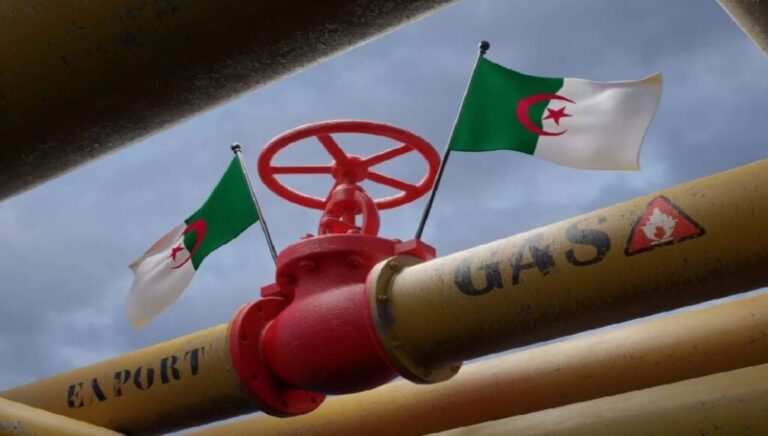
Faced with growing domestic consumption and pressure on its export revenues, Algiers plans to invest nearly 64 billion euros in the hydrocarbon sector by 2030 – a move that fails to address the underlying fragilities of its energy model.
Algeria intends to mobilise 71.6 billion dollars (approximately 63.8 billion euros) for the hydrocarbon sector by 2030. Presented on October 17 by Minister Mohamed Arkab to the National People’s Assembly, this program aims to increase primary production to 201 million tonnes of oil equivalent, up from the 193 million projected for 2026.
This ambition underscores, above all, the country’s difficulty in loosening its reliance on fossil resources.
According to the World Bank, hydrocarbons accounted for an average of 83% of Algerian exports between 2020 and 2024. Of the $71.6 billion announced, 52 billion will be allocated to exploration and production. Sonatrach has reported 17 new discoveries since January, and partnerships with foreign firms are intended to help replenish reserves.
However, such discoveries do not guarantee rapid development or additional volumes available for export.
Pressure is also mounting from the domestic market. National gas consumption reached 57.27 billion cubic meters in 2025 – an 8.9% year-on-year increase, according to Attaqa’s Energy Research Unit.
As gas is the primary fuel for electricity generation, a greater share is being diverted to meet domestic demand, creating a risk that the volumes available for export will shrink.
At the same time, Algiers plans to invest nearly $13 billion in refining and petrochemicals. The Hassi Messaoud refinery, with a projected capacity of five million tonnes per year, is intended, among other things, to reduce fuel imports.
Two polypropylene projects and an MTBE unit further support this industrial development initiative.
However, this strategy remains dependent on international price trends. Between January and September 2026, hydrocarbon sales generated $37.5 billion, bolstered by Algerian crude oil prices
hovering around $97 per barrel.
While this favourable climate is welcome, it cannot mask the underlying vulnerability of an economy whose external revenues remain heavily tied to fossil fuel markets.
Although the program expands the sector’s capacity, the broader challenge of economic diversification remains unaddressed.
MK/AK/Sf/fss/as/APA