



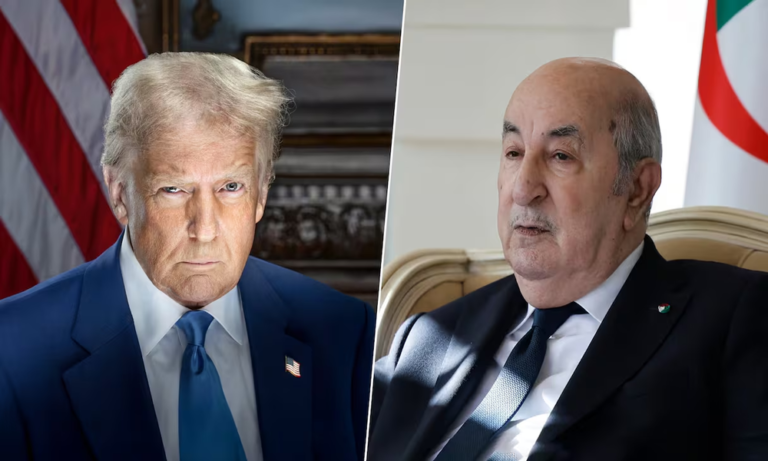
A report by American analysts highlights Washington’s growing focus on Algeria, whose military posture, diplomatic alignment and Sahelian footprint are raising increasing questions in Western security circles.
Long relegated to the margins of American strategic priorities, Algeria is attracting growing attention in several Washington security think tanks. According to recent reports, the evolution of international crises — the war in Ukraine, instability across the Sahel and shifting dynamics in the Middle East — is pushing U.S. strategists to take a closer look at the role of this military-led regime in North Africa.
Spanning 2.4 million square kilometers, Algeria is Africa’s largest country and occupies a pivotal geographic position between the Mediterranean and the Sahel. That territorial centrality places it in direct proximity to several major flashpoints, including Libya, Mali and Niger. For a number of Western analysts, this configuration gives Algiers considerable potential influence over the security balance of the entire region.
Observers have also flagged the country’s military buildup. With one of the continent’s largest defense budgets and an arms procurement portfolio drawn primarily from Russia, Algeria has significantly expanded its air, land and naval capabilities in recent years. For some Western intelligence services, this modernisation goes beyond purely defensive logic and could shift the strategic balance across the Maghreb and the Sahel.
On the diplomatic front, Algiers’ posture is equally a source of scrutiny. The country maintains close ties with several powers outside the Western bloc — notably Russia and Iran — while preserving economic partnerships with Europe. This orientation stands in contrast to the regional realignments that have taken shape since the Abraham Accords, and complicates Algeria’s integration into the security architecture Washington is seeking to consolidate across the region.
The Western Sahara file adds another layer of friction. Backed by Algiers and based for decades in the Tindouf camps, the Polisario Front stands in direct opposition to Morocco — a key U.S. strategic partner. Since Washington’s recognition in 2020 of Moroccan sovereignty over the Western Sahara, the issue has become an increasingly awkward dossier for Algiers.
MK/AK/te/Sf/lb/as/APA