



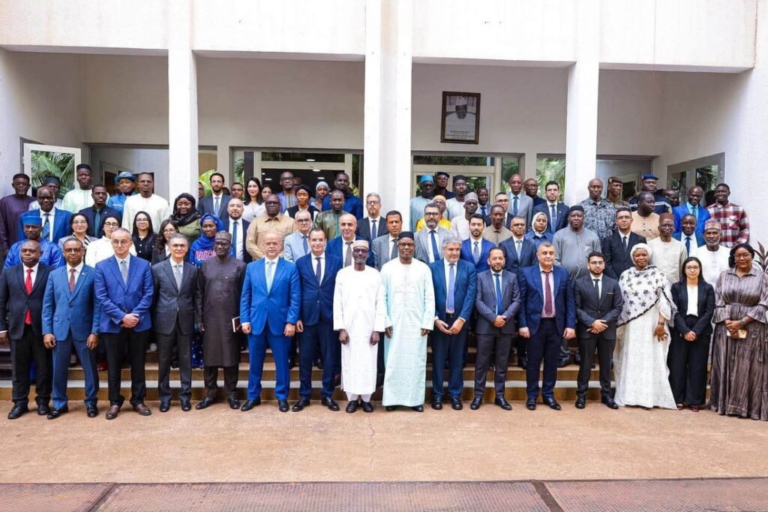
Mali and Morocco on Tuesday relaunched the work of their Joint High Commission, a bilateral cooperation mechanism that had not met for 26 years.
The fourth session, which opened with a meeting of experts in Bamako, is expected to culminate in the signing of new agreements aimed at strengthening trade, investment, and economic cooperation between the two countries. Malian and Moroccan experts have begun reviewing draft agreements that will be submitted to the foreign ministers of both countries during a ministerial session scheduled for July 24, following a business forum set for July 23. The expert discussions are co-chaired by Moustapha Traoré, Secretary General of Mali’s Ministry of Foreign Affairs, and Mohammed El Alaoui, Head of the African Affairs Division at Morocco’s Ministry of Foreign Affairs. Over two days, the delegations are reviewing existing cooperation programs and identifying new priorities in strategic sectors including trade, investment, agriculture, energy, infrastructure, mining, healthcare, vocational training, and higher education.
Established under an agreement signed in 1987, the Joint High Commission serves as the principal institutional framework for dialogue and monitoring cooperation between Bamako and Rabat, though its last meeting was held in Rabat in June 2000. A fourth session had previously been planned during King Mohammed VI’s visit to Mali in February 2014, a trip that resulted in the signing of 17 agreements covering investment, healthcare, water management, energy, telecommunications, transport, agriculture, and mining. The current Bamako meeting aims to assess the implementation of those past commitments, update cooperation mechanisms, and define new programs aligned with the present economic priorities of both nations.
A central focus of the renewed dialogue is the upcoming July 23 Business Forum, which will bring together companies, financial institutions, and private-sector representatives from Mali and Morocco to discuss investment opportunities, local value addition, business financing, and industrial partnerships. Trade flows currently remain heavily in Morocco’s favor, with 2025 estimates showing Moroccan exports to Mali reaching nearly $185 million, compared with roughly $3 million in imports from Mali. The Mali Chamber of Commerce and Industry aims to leverage the forum to facilitate direct contacts between business operators, attract greater investment, and secure crucial skills transfers. Moroccan companies already maintain a strong presence in the Malian economy, including Maroc Telecom operating through Moov Africa Malitel, Bank of Africa standing among Mali’s leading banking institutions, and OCP Group running programs to improve soil fertility and agricultural productivity.
The revival of this institutional mechanism comes amid a growing diplomatic rapprochement between Bamako and Rabat. In April 2025, Mali, Burkina Faso, and Niger backed Morocco’s strategic initiative to grant Sahelian countries access to Atlantic ports, offering landlocked Mali a vital opportunity to diversify its trade corridors. Bilateral relations deepened further in April 2026 when Mali officially withdrew its recognition of the Sahrawi Arab Democratic Republic (SADR) and endorsed Morocco’s autonomy plan for Western Sahara. Just days before the Joint High Commission meeting, Morocco was also featured as the guest of honor at the second International Diaspora Forum held in Bamako from July 16 to 18, fostering additional exchanges among investors, institutions, and entrepreneurs. After a hiatus of more than a quarter-century, both governments are now focused on translating their diplomatic alignment into concrete economic projects through the effective execution of the agreements set to emerge from this fourth session.
MD/te/Sf/lb/abj/APA