





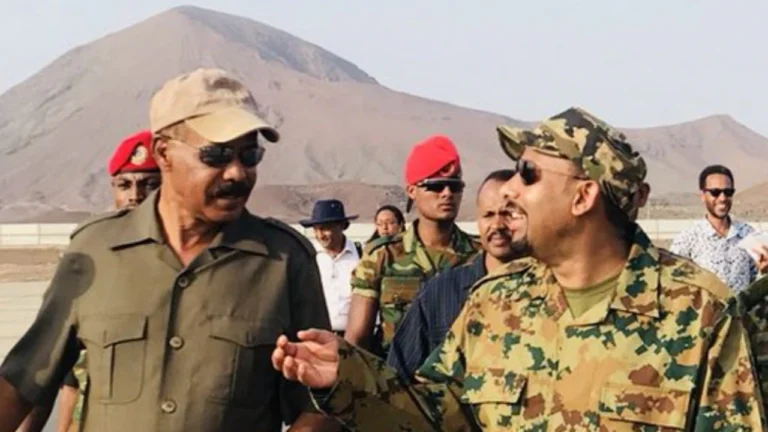
The Eritrean government is dismissing as a charade allegations that it is readying to wage war against neighbouring Ethiopia.
Their armies fought a bitter two-year border war which ended in 2000.
Both countries have been part of a federation which ended 32 years ago following a decades of a secession conflict.
In a letter addressed to the UN Secretary General Antonio Guterres earlier this month, the Ethiopian foreign ministry accused Asmara of colluding with a coalition involving a hard-line faction of the opposition Tigray People’s Liberation Front (TPLF) to destabilise Ethiopia.
The ministry also accused the Eritrean government and the TPLF of “funding, mobilising and directing armed groups” in the Amhara region, where federal forces have been battling rebels for more than two years.
Eritrea had previously expressed its own suspicion about landlocked Ethiopia’s maritime ambition which does not exlude the use of military force at the expense of Eritrean territorial sovereignty.
Addis Ababa had denied that it was militarily preparing to seize the port of Massawa which was ceded to Eritrea when it opted out of the federation. A section of Ethiopian public opinion resents the loss of that strategic port to Asmara which rendered Ethiopia landlocked.
“The intense propaganda campaign aimed at whipping up irredentist ambitions has been accompanied by provocative sabre-rattling,” Eritrean information minister Yemane Ghebremeskel said on Thursday while responding to Ethiopian accusation of drumbeating for war.
He condemned Addis Ababa’s letter to the UN articulating this claim as a “deceitful charade”.
Ghebremeskel also accused the authorities in Addis Ababa of undermining Eritrea’s “hard-won independence and sovereignty,” saying: “For the last two years, the regime’s policy mantra has revolved around acquiring sovereign access to the sea through legal means if possible, or military force if necessary.”
Relations between Ethiopia and Eritrea have been strained for more than two years following improved ties which followed Prime Minister Abiy Ahmad’s rise to power in 2018 .
Ethiopia has been hit by an increasingly brutal conflict in its Amhara region, after the Fano militias – previously allied with Prime Minister Abiy Ahmad ‘s government against the TPLF – rejected moves to disarm them and said they were defending the Amhara ethnic group from atrocities ostensibly by federal forces.
The Fano appear to be expanding their agenda which include an armed campaig to topple Abiy’s government, and are carrying out more deadly raids of state institutions.
MG/as/APA