



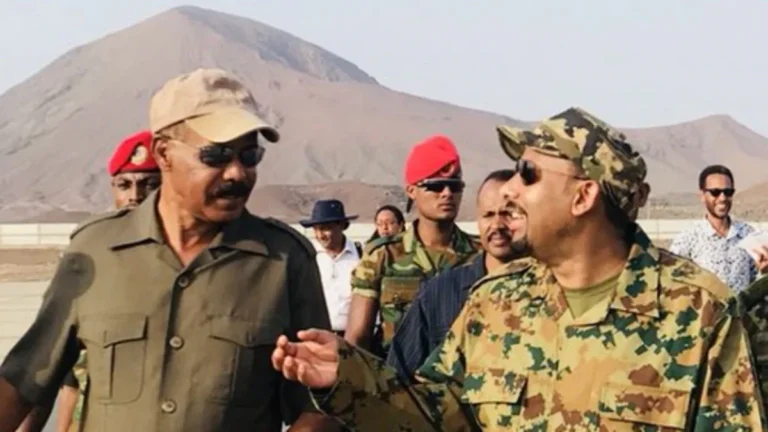
Asmara has called for meaningful international pressure on Addis Ababa to halt Ethiopia’s planned “massive war” against Eritrea in a ”desperate bid to gain maritime access”.
In a statement issued over the weekend, Eritrea’s Ministry of Foreign Affairs accused Ethiopia’s ruling party of seeking to “manufacture a veneer of international legitimacy” around its demand for “sovereign sea access,” which Asmara characterised as territorial revisionism.
Ethiopia became landlocked after Eritrea seceded from the federation in the early 1990s.
“Ethiopia had decided to go to war to acquire what it calls “sovereign access to the sea” and to establish a naval force in the Red Sea,’ the statement said.
Eritrea has accused Ethiopia of using maritime diplomacy and regional security forums to mask what it described as territorial ambitions in the Horn of Africa, escalating tensions amid renewed disagreements over Addis Ababa’s pursuit of access to the Red Sea.
The statement follows Prime Minister Abiy Ahmed’s address to the House of Peoples’ Representatives on Thursday in which he rejected claims that his country intends to invade Eritrea, but reiterated that access to the Red Sea remains a strategic imperative to be pursued through dialogue.
“Now they say, ‘Ethiopia is going to invade Eritrea, Ethiopia will wage an invasion for the Red Sea’—we will not wage an invasion. Invasion is not needed; we want it peacefully and through dialogue,” Abiy told lawmakers, likening Ethiopia’s maritime ambitions to the natural course of the Abay River.
In another development, Yemane Gebremeskel, Eritrea’s information minister, told the Eritrean parliament that he had found no evidence in Ethiopia’s official archives of proceedings or agreements on Eritrea’s independence.
He said Prime Minister Abiy Ahmed had told parliament he had found no evidence in Ethiopia’s official archives about the same issue.
Yemane also said Ethiopia’s deputy chief of staff, General Abebaw Tadesse, stated on September 27 that the goal of an offensive launched in Tigray was to occupy the Eritrean port of Assab and “install the Ethiopian flag in the Red Sea”.
Abiy claimed Ethiopia had made repeated efforts to pursue economic cooperation with Eritrea, including proposals to extend electricity infrastructure, build roads and jointly develop a port, but said the Eritrean government had rejected them.
“Because we are a large population; our disturbance disturbs many,” he said, arguing that Ethiopia’s stability was central to wider regional peace.
He also pointed to shifting geopolitical dynamics, including the potential opening of Arctic shipping routes, arguing that these could alter the Red Sea’s strategic importance in the coming years.
MG/APA