



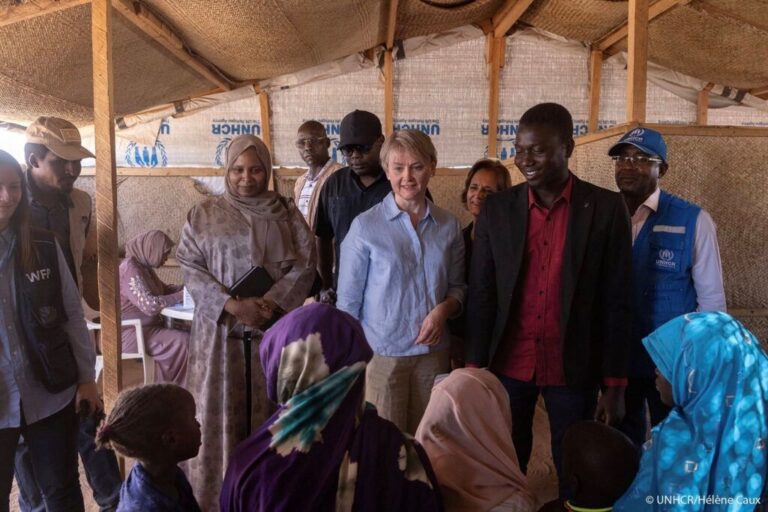
British official Yvette Cooper visited Adré to assess the humanitarian situation of hundreds of thousands of civilians fleeing violence in Sudan and to support protection and assistance efforts.
The town located on the border between Chad and Sudan, has become one of the main entry points for thousands of refugees from Sudan. It is against this backdrop of a major humanitarian crisis that the UK Minister of State for Foreign Affairs, Yvette Cooper, visited eastern Chad this week to evaluate the situation.
Alongside Chadian authorities, including the Minister Delegate for Foreign Affairs, the National Commission for the Reception and Reintegration of Refugees and Returnees (CNARR), and representatives of the United Nations High Commissioner for Refugees (UNHCR), the British minister met with refugee families who had recently arrived, often after journeys marked by violence, fear, and the loss of their livelihoods.
The visit, organised with the support of the World Food Programme (WFP), highlighted the scale of humanitarian needs in a region already weakened by poverty and disaster.
The delegation visited the refugee registration centre, a key mechanism for ensuring their identification, protection, and access to basic services.
The British official also visited a women’s centre run by Sudanese refugees, a true haven of protection and resilience where women find psychosocial support, a listening ear, and community
support in the face of trauma.
A food distribution site was also on the agenda. The WFP provides essential food assistance there to thousands of refugee families, whose survival largely depends on humanitarian aid.
This assistance also helps to reduce tensions with Chadian host communities, which are themselves facing significant pressure on natural resources, water, and social services.
Since the outbreak of war between the Sudanese army and the Rapid Support Forces (RSF), a paramilitary group, in April 2023, Chad has become a haven for thousands of families.
Settled in the provinces of Ouaddai, Wadi Fira, and Sila, the refugees are being cared for by United Nations agencies and the Chadian government.
Faced with financial difficulties due to the suspension of aid from the United States, these agencies have repeatedly warned of the risk of having to suspend their missions.
The British minister’s visit highlighted the urgent need to strengthen international solidarity in the face of a crisis that is expected to be protracted. It also underscored the ongoing efforts of Chad, a major host country, whose commitment remains essential for regional stability and the protection
of hundreds of thousands of lives.
CA/ac/fss/as/APA