



By Gabriel del Puerto, columnist
In Montevideo, drums evoke an African presence in a capital whose history is not defined solely by its European ties.
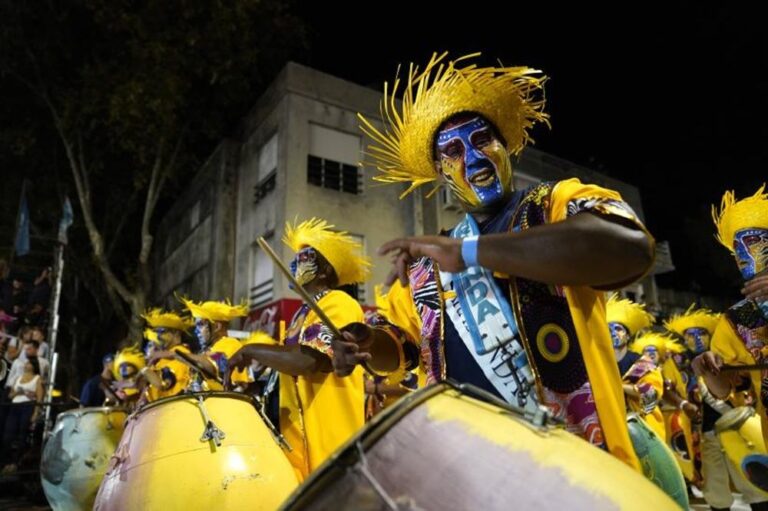
In the city’s southern neighbourhoods, ceremonies known as “llamadas” bring together musicians, dancers, and crowds of onlookers. Before setting off, participants traditionally gather around a fire to tighten the drum skins – a ritual that serves as a way to recognise one another, share knowledge, and reclaim their place in the streets.
Candombe evolved along the banks of the Río de la Plata, rooted in practices brought by African populations starting in the 17th century and subsequently transformed by their descendants. Over time, the original community gathering spaces gave way to carnival associations.
Far from being an African rhythm that has remained unchanged, candombe is an Afro-Uruguayan creation, shaped by the social and urban conditions of its adopted home.
Today, its musical language relies on three types of drums, each with a distinct sound; together, they create a rhythm that lends depth to a musical tradition learned through walking, listening, and observing others.
The techniques, gestures, and playing styles are passed down within families, as well as through training programs documented by Uruguayan cultural institutions.
Each neighbourhood possesses its own sonic memory. The “Cuareim” rhythm is associated with the southern districts; the “Ansina” rhythm is played in the narrow streets of the Palermo neighbourhood; and the “Cordón” rhythm is characteristic of the ‘Conventillo de Gaboto”.
These communal dwellings, which housed many Afro-descendant families, served as vital hubs for social interaction and musical development.
While some of these specific locations may have vanished, the distinct playing styles associated with them have retained their names.
The processions also carry a form of memory – expressed through the body and through attire. The ‘Mama Vieja’ (“old mother”) evokes female ancestry, while the “Gramillero’ – an old man carrying a satchel of herbs – alludes to the figure of the healer. Accompanied by flags and emblems, these characters are integral to the identity of the groups, which bring together percussionists and dancers in a light-hearted, convivial atmosphere.
Their costumes are never merely decorative; rather, they contribute to a collective narrative.
The grand procession known as ‘Las Llamadas’ (‘The Calls’) was incorporated into Montevideo’s official carnival in 1956, granting ‘candombe’ national visibility.
In 2009, UNESCO formally inscribed ‘candombe’ and its sociocultural space as a ‘community practice.’ This recognition encompasses both the music itself and the human fabric that sustains it.
Over time, this fabric has suffered tears. During the military dictatorship, entire families were dispersed – some moved into temporary housing and later relocated to the city’s periphery. The
places where ‘candombe’ had flourished were destroyed, yet the practice itself did not disappear.
Since 2006, December 3rd has been observed as the National Day of Candombe, Afro-Uruguayan Culture, and Racial Equity.
Today, the safeguarding of this tradition relies on several entities.
The ‘Casa de la Cultura Afrouruguaya’ (‘House of Afro-Uruguayan Culture’), inaugurated in 2011, supports the creation and dissemination of Afro-Uruguayan cultural expressions.
The association ‘Africania’ focuses on research, training, and the transmission of knowledge – particularly regarding percussion, dance, and traditional characters. In the southern district, the cultural association ‘Cuareim 1080’ combines workshops and rehearsals with the preservation
of the community’s history and its musical figures.
Public initiatives provide further support. The Interministerial Commission for the Support of Tango and Candombe funds initiatives for training, research, and preservation.
Such support is valuable, provided that it safeguards what makes candombe irreplaceable – namely, the families, the places, the masters, and the time required for learning.
GDP/ac/fss/as/APA