





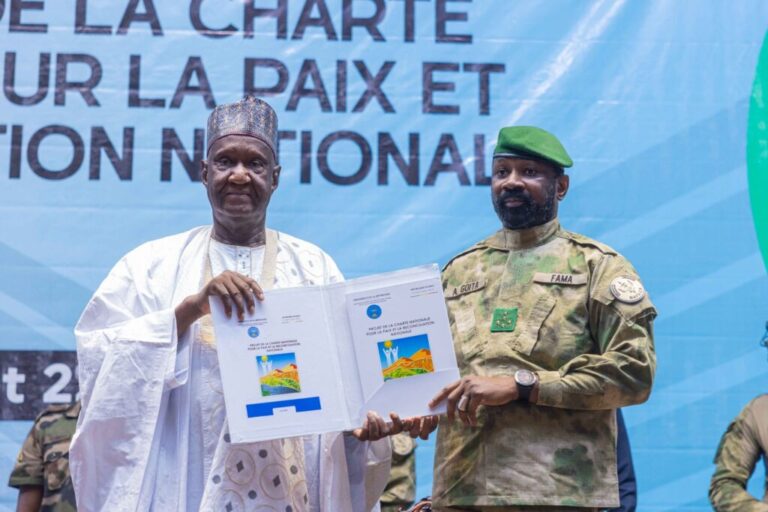
Touted as a roadmap for national reconciliation, the Charter for Peace, officially handed over to President Assimi Goïta on Tuesday, July 22, arrives behind schedule and is already raising questions about its adoption and effectiveness.
Nearly four months later than initially planned, Mali’s transitional president, General Assimi Goïta, received the draft National Charter for Peace and Reconciliation in Bamako.
The document, the result of a local process presented as a sovereign alternative to the 2015 Algiers Agreement—formally scrapped by the authorities in January 2024—was described by its drafters as a “historic milestone,” though concerns about its practical impact are already surfacing.
Originally expected in March 2025, the charter was presented during an official ceremony at the Bamako International Conference Center (CICB). The event was attended by government officials, religious and traditional leaders, elected representatives, and civil society actors. The head of the drafting commission attributed the delay to a desire to “include all voices,” citing extended consultations and “lively but constructive” debates.
According to its initiators, the charter aims to break away from “imported conflict resolution models” and directly addresses long-standing criticisms of the Algiers Agreement, seen as ineffective and lacking local ownership.
The draft document comprises 16 titles, 39 chapters, and 106 articles. It outlines concrete mechanisms for resolving community conflicts, supporting victims, reintegrating ex-combatants, and developing marginalised regions. It also reaffirms the unity and indivisibility of the Malian state and embeds the reconciliation process within a framework of national sovereignty.
The commission emphasised that consultations included all regions of Mali, the Bamako district, the diaspora, and various associations to ensure the document’s legitimacy and representativeness.
This handover comes amid a fragile political and security situation in Mali following the recent dissolution of political parties, armed clashes in the north and center of the country, a surge in jihadist attacks, and growing mistrust of foreign mediation. Since the rejection of the Algiers Agreement, some rebel factions have resumed hostilities, adding further pressure on the government.
The prime minister described the charter as a “rendezvous with sovereignty,” stating that it embodies the will of Malians to “take back control of their future.”
However, critics are already questioning the applicability of its provisions and the resources that will be allocated to implement them. In the media and on social platforms, several observers have noted the absence of a clear timeline for its adoption and rollout.
The charter still needs to be reviewed by the relevant institutions. The government has not clarified whether its adoption will require a parliamentary vote, a presidential decree, or a national referendum. Multiple sources suggest a popular vote may be held by the end of the year to strengthen public ownership of the process.
The commission urged the authorities to maintain the inclusive approach that guided the drafting phase. It also stressed that the charter should not remain a symbolic document but must serve as a legal and political foundation for a credible and lasting reconciliation process.
Handing over the document, the commission’s president described it as a “compass for present and future generations,” while President Goïta praised it as “an exemplary and essential effort to rebuild national cohesion.”
MD/ac/sf/lb/as/APA