





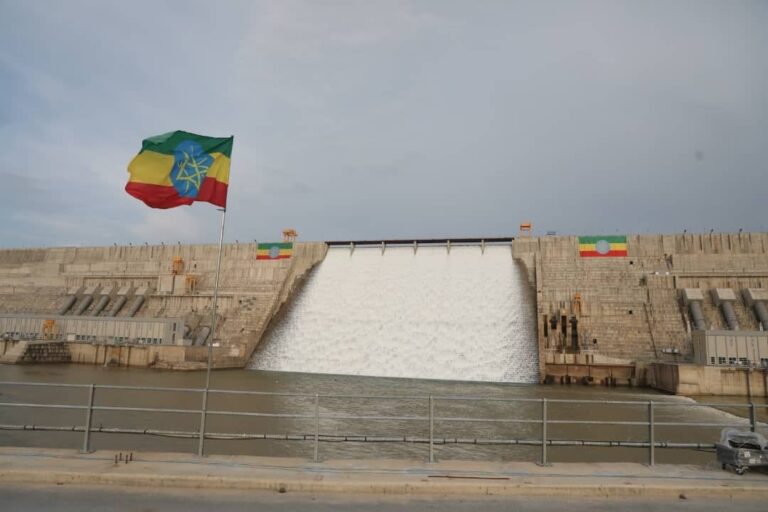
The Grand Ethiopian Renaissance Dam (GERD), Africa’s largest hydroelectric power project on the Blue Nile is officially inaugurated in the presence of several regional leaders despite a great hue and cry from two of its neighbours.
The leaders of Egypt and Sudan who oppose the project from the onset were absent.
The $4.2 billion dam, with 74 billion cubic meter water holding and 5,150-megawatt generating capacity is expected to reorganise the power dynamics in the Nile Basin countries especially between Ethiopia, Egypt and Sudan.
Since its inception in 2011, Cairo and Khartoum have made frantic appeals to the international community and in some circumstances warning Ethiopia to stop or modify the construction and operation of the dam or face the prospect of open sabotage.
Both countries say Gerd will adversely affect their water security provided by the world’s longest river.
Ethiopian Prime Minister Abiy Ahmed along with dozens of other African leaders participated in the inauguration of the dam, located about 40 kilometers east of Ethio-Sudanese border.
The ceremony was attended by Ismaïl Omar Guelleh, President of Djibouti, Salva Kiir Mayardit of South Sudan, Somali President Hassan Sheikh Mohamud, Kenyan leader William Samoei Ruto, Mia Amor Mottley, Prime Minister of Barbados, and Russell Mmiso Dlamini, the Prime Minister of Eswatini.
Also present were Mahmoud Ali Youssouf, Chairperson of the African Union Commission, Claver Gatete, United Nations Under-Secretary-General and Executive Secretary of the United Nations Economic Commission for Africa (UNECA).
Speaking at the inaugural event, Ethiopian PM Ahmed once again reiterated that his country’s intention was far from harming any of its neighbours and pointed out that Gerd was geared toward uplifting economies and the quality of life for people in the Horn of Africa region.
He said the project was financed entirely through domestic sources, crowdsourcing, internal fundraising, bond sales, and employee salary contributions.
Ahmed said Ethiopia remains grateful to its late emperor Haile Selassie who first came up with the idea of building a dam at the same location over the Nile and lauded late Prime Minister Meles Zenawi for pursuing the project despite pressure from international powers. He also praised his predecessor Hailemariam Dessalegn for continuing where Meles had left off.
Nile history mired in controversy
A 1929 Anglo-Egyptian Treaty granted Egypt 48 billion cubic meters of annual water allocation and veto power over upstream projects, later increased to 55.5 billion cubic meters in a 1959 agreement with Sudan.
Those agreements had excluded Ethiopia, which contributes over 80 percent of the Nile waters.
Egypt and Sudan, however, have been raising concerns that the dam could potentially reduce their share of water from the Nile, a claim dismissed by the engineers as misleading and overly exaggerated.
In July 2025, Egypt’s Foreign Minister Badr Abdelatty announced that talks with Ethiopia have officially stalled, marking “the end of 14 years of negotiations” and yielding no diplomatic result.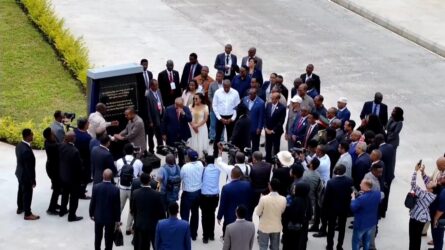
Ethiopia has been accusing Egypt of launching diplomatic warfare against the dam including lobbying international financial institutions to deny funding, pressuring construction companies to withdraw, orchestrating media campaigns portraying the dam as an ecological disaster, and allegedly supporting opposition groups to destabilise the government in Addis Ababa.
The two downstream states had suggested that filling the dam should take about 12 to 21 years in order to protect their water supply. Addis Ababa, however, preferred a shorter filling period. Egypt and Sudan had also argued that the filling should be carried out after a legally binding agreement, which Ethiopia rejected.
Despite the intervention of the African Union and the US government, as well as appeals by Egypt to the UN Security Council, the three countries have not been able to secure a deal.
Ethiopia had rather pressed ahead with dam’s construction and filling. The fifth and final filling was completed in October 2024, bringing the reservoir to its full capacity of 74 billion cubic meters.
The mega dam is expected to double Ethiopia’s current output, part of which will be exported to her neighbours, some of whose leaders witnessed Tuesday’s inauguration.
Cementing Ethiopia’s Horn prestige
The East African nation insisted that the towering dam will not only benefit its more than 120 million people, but also its neighbours, and sees it as an opportunity to become Africa’s leading power exporter.
Now GERD is operational, it is expected to fundamentally reshape water management in the Nile Basin.
Economists say the economic implications of GERD extend far beyond electricity generation, promising to reshape the entire Horn of Africa’s economic landscape. Currently, around 60 million Ethiopians remain without electricity, with many industries operating at reduced capacity due to inconsistent power supply.
GERD was created to directly address this fundamental constraint on national development.
The projected output of over 5,000 megawatts is expected to alleviate production constraints, allowing for increased efficiency. This stable electricity supply will serve as a magnet for both local and foreign investment, fostering manufacturing sectors, agro-processing industries, and technology hubs.
The seven-year delay from the original 2017 completion date represents significant opportunity costs, with Ethiopia forgoing substantial revenue from electricity sales.
The reductions in turbine capacity and delays have cost billions in lost revenue.
Despite these setbacks, the long-term economic benefits far outweigh the costs, with GERD embodying Ethiopia’s transition from an agrarian economy to a diversified industrial powerhouse.
MG/as/APA