





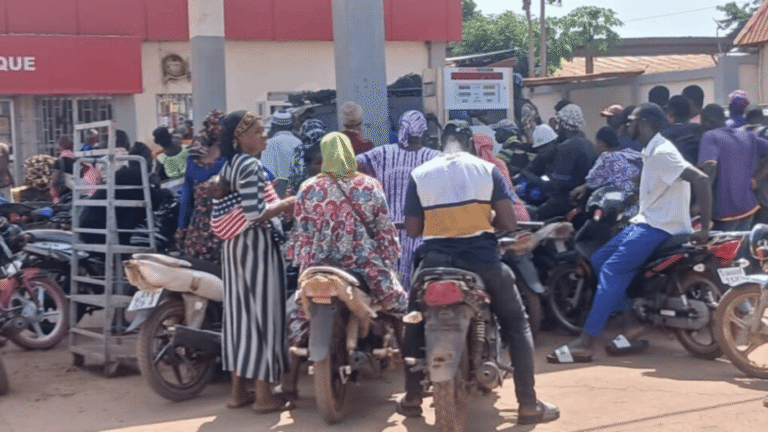
The eastern city of Kankan in Guinea is grappling with a sudden and severe fuel shortage, resulting in massive queues at the few operational gas stations.
This supply crisis coincides with the peak of the Ramadan and Lenten seasons, a period typically characterized by high travel demand and increased economic activity. Despite assurances from the National Petroleum Company (SONAP) that fuel stocks are sufficient nationwide, residents report that gasoline has become nearly impossible to find in both the city center and outlying neighborhoods.
The shortage has even paralyzed the local black market, with reserves reportedly depleted as of Wednesday. In response to the crisis, the Prefectural Council of Civil Society Organizations (CPOSC) has accused some station managers of price gouging and hoarding, practices that have significantly worsened the situation for the local population. CPOSC President Ibrahima Toure has called on municipal and prefectural authorities to provide a transparent inventory of available fuel and safety stocks to restore public confidence.
To curb further speculation and illegal trafficking, the CPOSC is advocating for stricter monitoring at service stations and legal action against those involved in fuel embezzlement. The organization emphasizes that deterrent sanctions are essential to prevent further disruption to local economic activity during this sensitive religious period.
As of March 4, 2026, the retail price for gasoline and diesel in Guinea is regulated at approximately 12,000 GNF per liter. However, localized shortages like the one in Kankan often lead to much higher unofficial prices. While the government recently extended its supply contract with Oryx Energies to maintain stability, structural issues—including reliance on a temporary storage solution provided by the Turkish group Albayrak—continue to make regional distribution vulnerable to shocks.
RNK/te/Sf/fss/abj/APA