



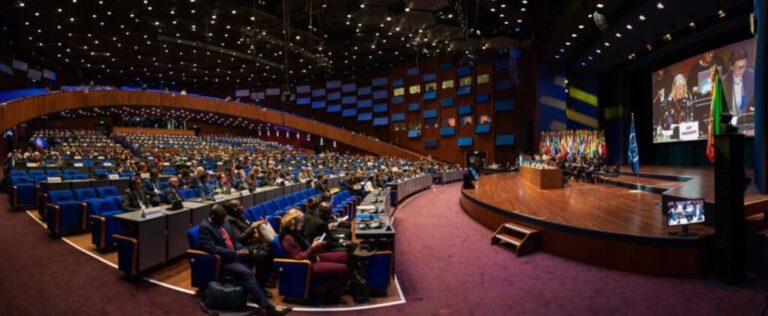
The Presidency of the Assembly of States Parties to the Rome Statute expressed its concern regarding the decision by Burkina Faso, Mali, and Niger to withdraw from the International
Criminal Court (ICC).
The ICC believes this choice could undermine global efforts to combat impunity and called for continued dialogue within the multilateral framework.
It said their exit risks weakening the international criminal justice system.
In a statement, the Presidency regretted these developments, recalling that the ICC is a pillar of the global accountability framework and that its effectiveness depends on the sustained commitment of member states.
This reaction comes in the context of the announcement made in September 2025 by the Confederation of Sahel States (AES), which includes the three countries, declaring their immediate withdrawal from the Rome Statute.
The Sahelian authorities had justified this decision by their desire to prioritise regional justice and peace mechanisms, denouncing the ICC as an “instrument of neo-colonial repression.”
The governments of the Sahel-Saharan Economic and Social Affairs (ESA) now state their intention to build an autonomous Sahelian judicial architecture, including a proposed Sahelian Criminal Court to try serious crimes within the confederation, as well as internal peacebuilding mechanisms.
In light of this development, the Presidency of the Assembly of States Parties called on the three countries to maintain their participation in the Assembly’s work and to pursue constructive dialogue, emphasising that each state has the right to express its concerns within this framework.
It also reiterated that withdrawal from the Rome Statute does not release a state from the obligations undertaken during the period when it was a party to the treaty, stressing the continuity of legal commitments.
In its statement, the Presidency noted that Burkina Faso, Mali, and Niger have historically contributed to the work of the ICC and encouraged continued dialogue to prevent any disruption in
international judicial cooperation.
The Assembly of States Parties, the administrative and legislative body of the ICC, comprises the states that ratified the Rome Statute and oversee the court.
AC/fss/as/APA