



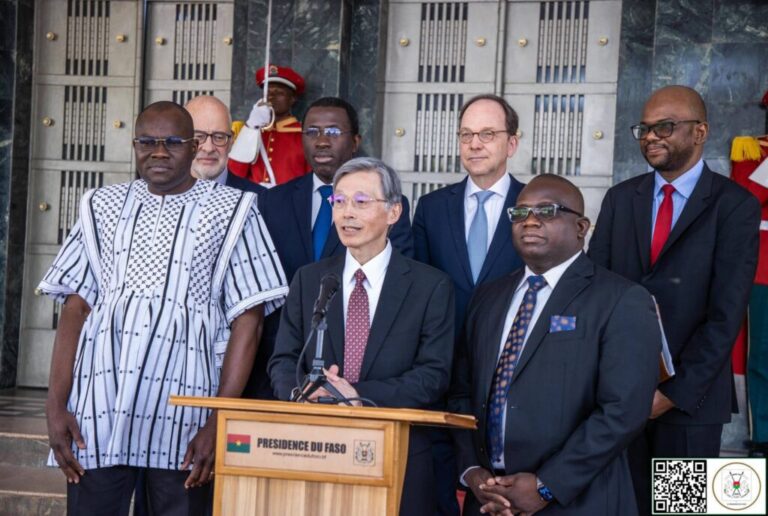
A high-level delegation from the International Monetary Fund (IMF) was received in Ouagadougou on Wednesday during which the Bretton Woods institution officials made lavish praise on the
country’s macroeconomic management, despite a challenging security situation.
Captain Ibrahim Traore, granted a major audience to the delegation from the IMF led by its Deputy Managing Director, Kenji Okamura.
The meeting, combined with a working session with the Minister of Economy and Finance, Dr. Aboubakar Nacanabo, resulted in an extremely positive assessment of the national economic trajectory.
The IMF’s assessment is unequivocal: The Burkinabe economy is demonstrating exceptional resilience. “Public finances are stabilising, key reforms are underway, and the macroeconomic framework is strengthening,” Kenji Okamura said while emerging from his meeting with the
president.
The Deputy Director General expressed his admiration for Captain Traoré’s “clear vision,” whose current policies are keeping the country on course for growth despite regional and international pressures.
This resilience inspired a striking metaphor from Jaroslaw Wieczorek, the IMF mission chief for Burkina Faso, who was also present.
“Burkina Faso is like its flag, a shining star,” he claimed, emphasising that the country is successfully implementing both profound structural reforms and rigorous management of its domestic resources.
Structural reforms bearing fruit
At the heart of the talks, the Extended Credit Facility (ECF) program was thoroughly reviewed.
Representatives of the Fund commended the progress made in financial governance and the digitalisation of the administration. These efforts have enabled better mobilisation of state revenue, essential for financing the war effort while preserving social stability.
Dr. Aboubakar Nacanabo, for his part, reiterated the authorities’ commitment to continuing these transformations. “The Deputy Director General’s visit is a strong signal of confidence,” a ministry
spokesperson emphasised, specifying that economic stability remains the strategic lever for national transformation.
Far from simply observing the situation, the meeting looked to the future. The IMF reaffirmed its commitment to playing a “catalytic” role within the international community.
The institution pledged to help the country mobilise additional technical and financial partners to amplify support for Burkina Faso’s Sovereign Development Plan.
“The partnership between Burkina Faso and the IMF is strong and more robust than ever,” concluded Kenji Okamura.
This international endorsement validates a strategy of economic sovereignty which, although bold, now seems to be bearing fruit on the stability indicators of the sub-region.
HO/ac/fss/as/APA