





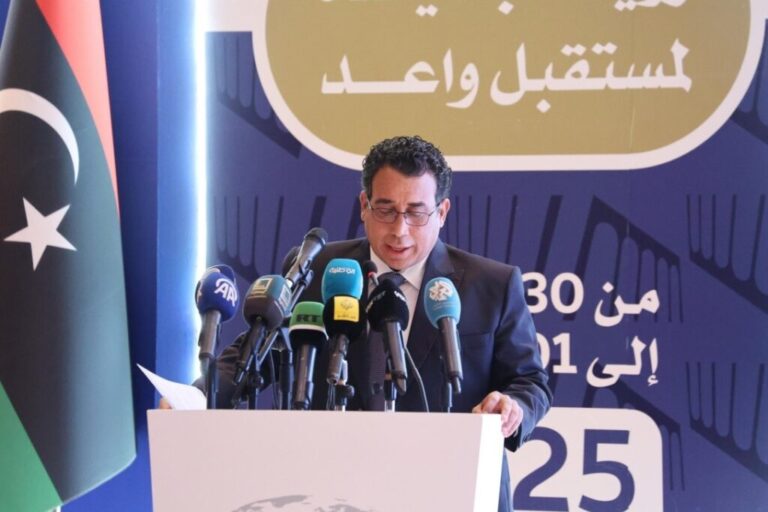
The head of Libya’s Presidential Council, Mohammed Menfi, reaffirmed Tripoli’s commitment to reactivating Libya’s role within regional organizations and employing more effective diplomacy to support the country’s full return to the international stage.
Speaking at the opening of the Conference on Libyan Diplomacy, themed “A New Vision for a Promising Future,” Menfi stated on Monday that Libya is committed to regaining its place within continental and regional blocs, specifically naming the African Union, the Community of Sahel-Saharan States (CEN-SAD), and the Arab Maghreb Union (UMA).
Menfi asserted that revitalizing Libya’s external role hinges on strengthening diplomatic performance and improving the organization of the state’s foreign policy structure.
Crucially, he stressed the need to protect Libyan assets frozen abroad, reiterating that these funds constitute a “heritage belonging to future generations.” He affirmed that any successful international return strategy must be accompanied by rigorous management of the country’s foreign investments, which have been a source of political and legal tension since the fall of the Gaddafi regime.
Prime Minister Abdulhamid Dbeibah, also present at the conference, highlighted several tangible diplomatic advances demonstrating a “more active” Libyan diplomacy focused on protecting citizens and heritage: Citizen Returns: The return to Libya of 38 nationals previously detained abroad. Security Lifts: The lifting of security restrictions affecting 936 people. Heritage Recovery: The recovery of more than 20 archaeological artifacts from illicit trafficking.
Dbeibah also underscored the gradual expansion of the foreign diplomatic presence in Libya. He indicated that 76 foreign missions are now active, including 45 embassies and consulates operating from Tripoli, with 25 other missions having resumed their activities within the country.
Furthermore, five international organizations have reactivated their operations. This shift is being supported by an increase in air links and the adoption of new visa procedures designed to facilitate regional exchanges. As part of ongoing reforms, the Prime Minister confirmed a strategic reduction in the number of Libyan diplomatic missions abroad, a measure intended to streamline costs and improve the network’s overall efficiency. He concluded by announcing a cultural diplomacy initiative focused on promoting national heritage, which includes the long-awaited reopening of the National Museum.
MK/Sf/fss/abj/APA