





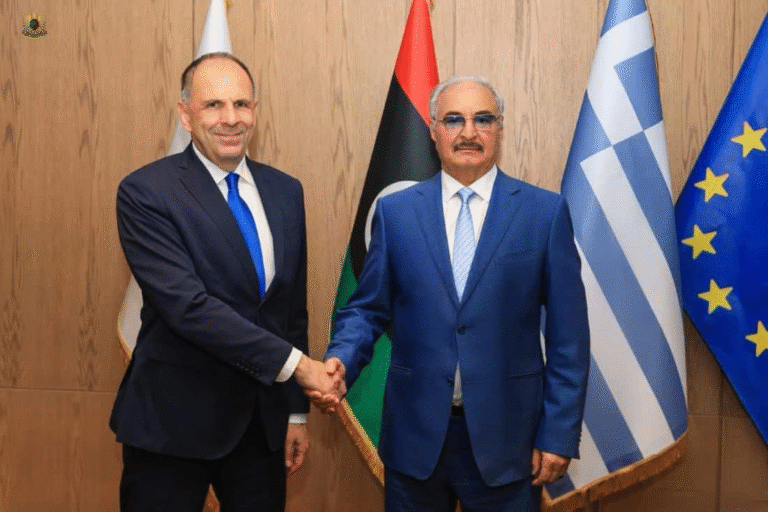
Field Marshal Khalifa Haftar, the strongman of eastern Libya, received Greek Foreign Minister Giorgos Gerapetritis on Monday during an official visit marked by high-stakes political and economic talks.
The meeting signals the deepening of ties between Greece and Cyrenaica, the stronghold of the Libyan National Army (LNA).
During the talks, both leaders advocated for a Libyan-led political resolution, national sovereignty, and a renewed focus on economic development.
Haftar emphasised the importance of a “patriotic compromise” between Libya’s rival institutions, firmly rejecting foreign interference.
According to him, only an internally driven reconciliation process can achieve lasting stability in his country. He also called for the establishment of a unified authority that respects Libya’s regional diversity.
The Greek delegation, which included senior economic and diplomatic officials, expressed a strong desire to expand bilateral cooperation—particularly in energy, security, and port infrastructure. Among the proposed projects were offshore gas development, the reconstruction of Derna’s port—devastated by Storm Daniel in 2023—and the creation of a commercial corridor linking Cyrenaica to the Eastern Mediterranean.
A joint statement released after the meeting underscored a “shared vision for a calm inter-Libyan dialogue, preferably facilitated by neighbouring states rather than dictated solely by UN mechanisms.”
Minister Gerapetritis praised what he described as “relative stability” in eastern Libya and called for “credible and transparent national elections.”
The visit, widely interpreted as implicit support for the eastern faction, drew sharp criticism from the Tripoli-based Government of National Unity, recognised by the United Nations.
Libya’s Ministry of Foreign Affairs condemned the meeting as “a violation of Libyan sovereignty” and rejected any legitimisation of parallel authorities.
This diplomatic overture comes amid broader geopolitical realignments in the Mediterranean. In its ongoing maritime dispute with Turkey over the Aegean and Eastern Mediterranean, Greece is seeking to expand its strategic partnerships in North Africa—especially through a stronger presence in Cyrenaica.
On the ground, the Cyrenaica National Development Agency, the LNA’s economic arm, is stepping up efforts to attract foreign investment for post-disaster reconstruction.
Though these projects hinge on a minimum level of stability, they reflect the region’s ambition to position itself as an autonomous and appealing international player.
MK/te/sf/lb/as/APA