





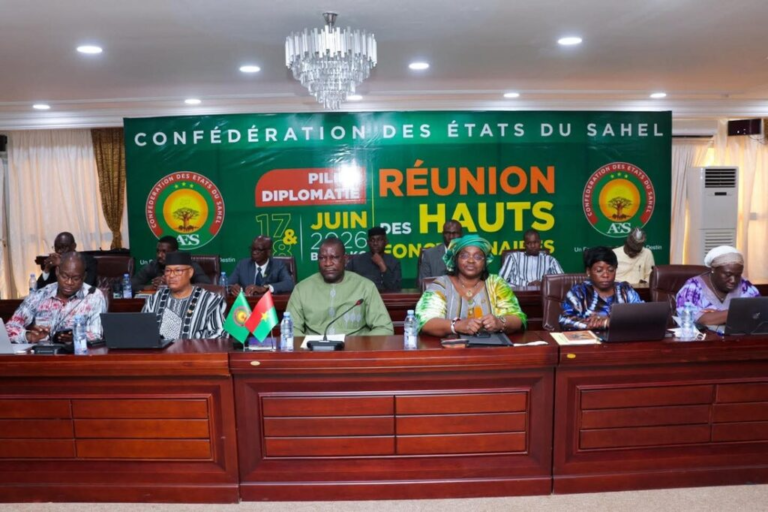
Senior officials responsible for the “Diplomacy” pillar of the Alliance of Sahel States (AES) opened talks in Bamako.
The talks which opened on Wednsday aim to lay the groundwork for an upcoming summit of foreign ministers and to solidify a unified stance between Mali, Burkina Faso, and Niger.
The proceedings are being chaired by Ambassador Dié Milogo, head of the Burkinabé delegation, whose country currently holds the rotating presidency of the Confederation of Sahel States (AES). Over the course of two days, delegations from Mali, Burkina Faso, and Niger will review several political, legal, and diplomatic frameworks tied to implementing the Year II roadmap of the AES.
The meeting serves as a preparatory step for the Confederation’s Council of Foreign Ministers. It is designed to allow the three nations to align their positions ahead of ministerial arbitration, particularly regarding relations with bilateral and multilateral partners, joint representation, and the defense of strategic interests within the confederal bloc.
The talks come amid the progressive institutionalisation of the AES. Initially established as a defense alliance in September 2023, the organisation was upgraded to a confederation on July 6, 2024, in Niamey.
Mali, Burkina Faso, and Niger subsequently formalised their withdrawal from the West African regional bloc ECOWAS on January 29, 2025, before deepening their cooperation across three core pillars: defense and security, diplomacy, and development.
In February 2026, Bamako ratified several additional protocols focusing specifically on diplomatic coordination, defense, and development. These texts are intended to provide a solid legal framework for the confederation’s decision-making mechanisms and common policies.
The ultimate goal of the Bamako meeting is to translate these strategic guidelines into operational tools. The discussions could also pave the way for future directives from the alliance’s heads of state, provided the reviewed documents receive formal ministerial approval.
For the three Sahelian capitals, diplomacy has taken center stage. Following their exit from ECOWAS—and within a geopolitical landscape shaped by shifting alliances—Bamako, Ouagadougou, and Niamey are seeking to speak with a single voice in regional and international forums.
This coordinated approach is also designed to regulate external partnerships at a time when the AES aims to assert its political autonomy and bolster its profile as a key regional player.
MD/te/lb/as/APA