





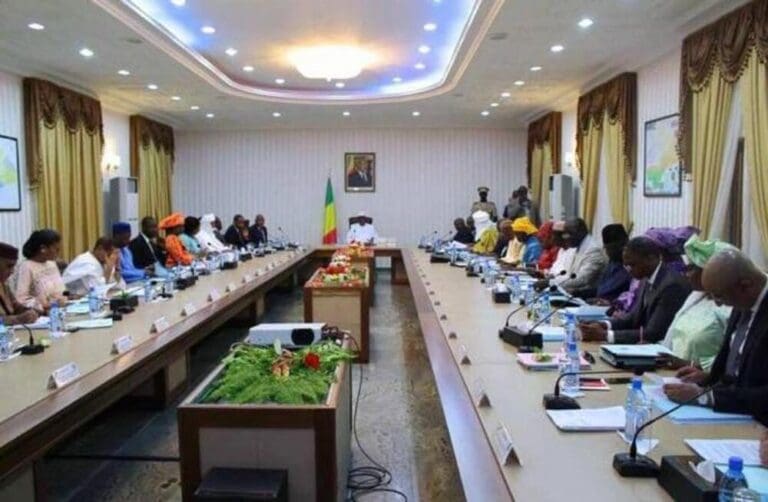
Following the Council of Ministers meeting held on April 9, 2025, under the chairmanship of the Head of State, the Malian government announced the organisation of a national consultation on the review of the Charter of Political Parties.
The initiative to review the party system in Mali is part of the implementation of the recommendations of the National Recondition Conference and response to the urgent need to clean up the national political landscape.
Mali is embarking on a new phase of the overhaul of its political system with the organisation in April 2025, of a broad national consultation on the review of the Charter of Political Parties.
This government initiative follows the recommendations of the National Recondition Conference to address recurring criticisms of the excessive fragmentation of the political landscape and the abuses observed since the advent of full multiparty politics in 1991.
This consultation will take place in two phases. The first, regional, is scheduled for April 16 and 17 in the country’s 19 administrative regions, the Bamako district, and 49 embassies and consulates abroad.
The second, national, will take place on April 28 and 29 in Bamako and will bring together regional delegates, representatives of the Bamako district, and representatives of Malians living abroad.
The objective is to gather proposals from political parties, civil society organizations, and representatives of Malian communities on how to revise the Charter.
The goal will be to formulate specific recommendations to further regulate political life, particularly the creation, operation, and financing of parties.
With approximately 300 legally recognized parties to date, the Malian party system is regularly described as bloated, inefficient, and clienteles’. Reforms are being considered to impose stricter conditions on party creation, reduce their number through mergers, and put an end to the dynamic of party creation for electoral purposes or personal convenience.
Political transhumance, a widely criticized phenomenon where elected officials change allegiance during their term to join another party or the presidential majority, is another central point of the debate. It is proposed to prohibit this behavior by legal means, with sanctions up to and including forfeiture of office for elected officials who leave the party under which they were elected.
The status of the opposition leader, long unclear in Malian institutional practice, is also being discussed. The consultations could lead to the establishment of a formal legal status granted to the leader of the party with the largest number of seats in the National Assembly, with benefits and official recognition guaranteeing their role in democratic debate.
The method of financing political parties is also being questioned.
Currently, the Malian government provides budgetary support equivalent to 0.25% of annual tax revenue, distributed among eligible parties, according to their representativeness.
Proposals aim to eliminate this public funding or make it more stringently conditional, in order to favour truly active and representative parties.
Against all odds, this national consultation embodies a political desire to restore the credibility of the party system and strengthen citizen participation in democratic life. In a context of prolonged political transition and distrust of institutions, these reforms could mark a structural turning point for Mali’s governance.
MD/Sf/te/fss/gik/APA