



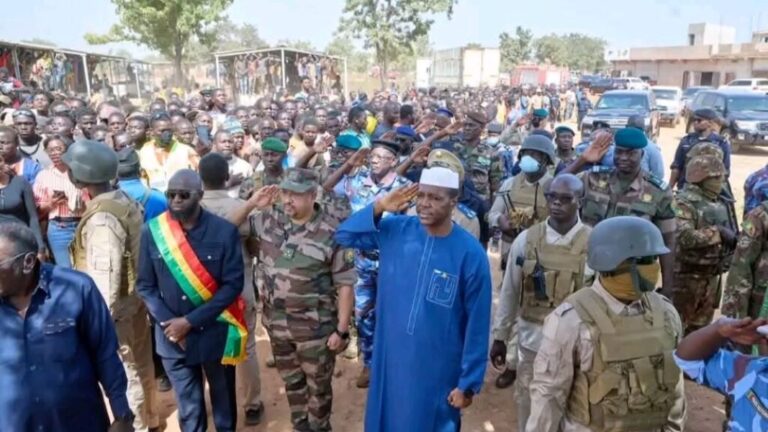
Nearly 160,000 people have arrived in Mali from Guinea – with approximately 100,000 reaching the Bamako district and 60,000 arriving in Kouremale – following operations targeting unregulated artisanal gold mining in the Siguiri region of Guinea.
Six deaths have been recorded in this border town, which Prime Minister Abdoulaye Maiga visited on Sunday, November 8, 2026, to assess the arrangements for providing assistance and facilitating the return of those affected.
According to communiqué no. 2026-06 from the Crisis Coordination and Management Centre (CECOGEC), released on Saturday, November 7, these movements involve nationals from several West African countries – most notably Mali and Burkina Faso – who have left gold-mining areas in
Guinea.
The official report also notes several injuries and six deaths in Kouremale, though it does not specify the circumstances surrounding these fatalities.
These estimates, which represent a significant increase over the initial figures reported, remain to be verified. The authorities have not provided details on their census methodology, nor have they
clarified the extent to which subsequent movements between Kouremale and Bamako were accounted for.
In response to this situation, the Malian government has strengthened measures for receiving these individuals, ensuring their security, providing medical care, and organizing their return to their respective home countries.
Assistance extended to several regions
On Sunday, Prime Minister – and Major General – Abdoulaye Maiga travelled to Kouremale, in the Kangaba Cercle, accompanied by members of the government and the National Transitional Council (CNT). There, he met with local authorities – notably village chief Ladji Sina Keïta and the mayor of the rural commune of Benkadi, Mamby Keita – who outlined the efforts made by the local population to welcome those arriving from Guinea.
The government delegation delivered food supplies, including rice, pasta, sugar, and oil, as well as four heads of cattle. Medicines valued at seven million CFA francs were also provided, alongside an
equipped forward health post.
These interventions were organised with the support of the Ministry of Health and Social Development and the Commission for Food Security.
The head of government commended the mobilization of the local population and humanitarian partners, while also calling on truck owners to assist with transport operations.
According to data released on Sunday by the CECOGEC, the movement of people also extends to other regions of the country.
Nearly 5,000 individuals have been reported in the Bougouni region – specifically in Yanfolila, Selingue, and Kalana. The Kita region is hosting approximately 500, while the Kayes region – primarily in Kenieba – is hosting 400.
These figures pertain to additional host areas and cannot simply be added to previous estimates, given that the individuals in question may have moved multiple times.
Return operations underway.
Malian and Burkinabe authorities have also bolstered transport capacity to facilitate the return of Burkinabe nationals.
According to new data from the CECOGEC, as reported by the Malian press, Mali deployed 63 trucks and 39 buses on Saturday, November 7, to transport approximately 14,000 people to Burkina Faso.
An additional 48 buses from Burkina Faso were also utilized to assist in the return of nearly 3,000 more individuals. On Sunday, the response effort was bolstered by the addition of 54 trucks and 24 buses from Mali, along with 38 coaches from Burkina Faso.
These resources supplement operations that have been underway since November 5, which had already enabled nearly 3,430 people to reach Burkina Faso.
Regarding healthcare, medical facilities in Bamako conducted 760 consultations, according to a report released on Sunday.
Authorities also noted the transfer of 232 individuals from Kenieba to the capital.
Furthermore, an emergency reception site has been set up and secured in Ouinzinbougou, in the Bamako district. Relevant services are continuing the process of identifying, registering, and directing those who have arrived.
The CECOGEC has called on regional authorities to remain mobilised and has invited organisations and individuals wishing to provide support to coordinate their efforts with the structures tasked with managing the crisis.
These population movements follow measures taken by Guinean authorities against illegal gold mining in the Siguiri region, near the Malian border.
Conakry justifies these operations by citing the need to enforce mining regulations, protect the environment, and put an end to unauthorised mining activities.
On Saturday, November 7, the Guinean government also announced the arrest of 1,263 individuals of various nationalities as part of these operations. This figure refers to those arrested in Guinea and should be distinguished from estimates regarding arrivals in Mali.
The crisis has thus mobilized several Malian and Burkinabe government agencies, which face the dual challenge of providing humanitarian assistance and organising returns, while thousands of people remain in transit zones.
MD/te/Sf/fss/as/APA