



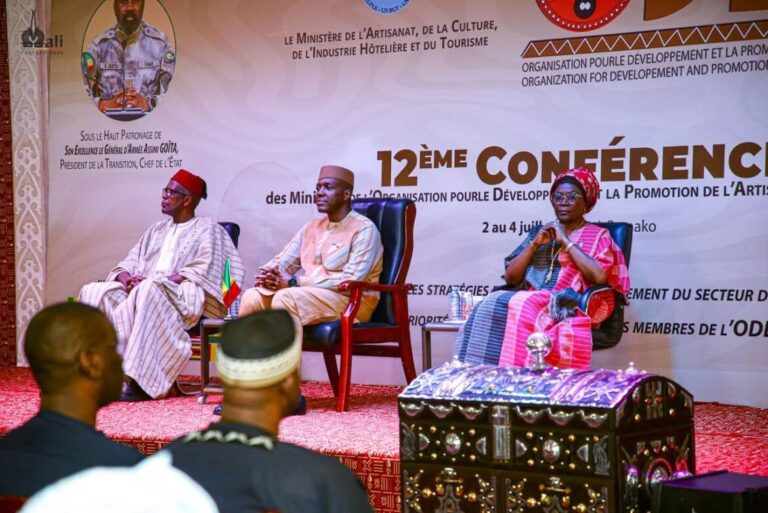
Mali has officially assumed the rotating presidency of the Organisation for the Development and Promotion of African Crafts (ODEPA) for the 2026–2027 term.
The transition occurred during the organization’s 12th Conference of Ministers held in Bamako under the theme, “What strategies are needed to reposition the craft sector among the development priorities of ODEPA member states?”. The ministerial summit followed a preliminary meeting of experts held on July 2–3, which concentrated heavily on the organization’s legal framework, governance structure, and strategic direction.
Convened under the high patronage of Malian transitional president Assimi Goïta, the event was officially opened by Prime Minister Abdoulaye Maïga. Delegations from 16 countries attended the gathering, including nine ministers representing Benin, Burkina Faso, the Central African Republic, the Republic of the Congo, Libya, Mali, Madagascar, Mauritania, and Niger. In recognition of his leadership, the participating ministers designated General Assimi Goïta as the “Champion of African Crafts” for the 2026–2027 period, a role that tasks him with advocating for the development agenda of the artisan sector at the highest political levels.
Founded in Burkina Faso in 1992, ODEPA functions as a pan-African platform for policy consultation, reflection, and collaborative action aimed at promoting craftsmanship across its 28 member states, which span four distinct regional zones. The organization operates to strengthen the sector, preserve traditional know-how, improve international market access, and secure financing for local artisans. Data presented during the Bamako summit underscores the immense economic importance of this sector, noting that crafts account for between 30 and 60 percent of the urban workforce in member countries and contribute between 5 and 30 percent of gross domestic product depending on the nation, serving as a primary driver for job creation, local development, and skills transmission.
The Bamako conference introduced significant updates to the scheduling of the organization’s governing bodies, establishing that ministerial conferences will now occur annually in March, while regional conferences will take place between September and October. Under the newly restructured governance framework, Morocco was elected First Vice-President and will host the 13th Conference of Ministers in March 2028, followed by Madagascar as Second Vice-President hosting the 14th Conference in March 2029, and Niger as Third Vice-President hosting the 15th Conference in March 2030. Regional coordinator roles were also assigned, with the Central African Republic leading Central Africa, Mauritania managing North Africa, Niger coordinating West Africa, and Madagascar overseeing Southern and Eastern Africa.
On an institutional level, delegates formally adopted the 2024–2026 mandate report presented by the outgoing president, Irène Marie-Cécile Mboukou-Kimbatsa Goma, along with the technical expert reports, while strongly emphasizing the critical need to bolster ODEPA’s internal governance. To achieve this, the conference passed a resolution to hire an independent auditing firm within two months through a call for expressions of interest to review the accounts and clarify the organization’s true financial standing. Furthermore, ministers authorized the design of fresh governance tools, including an updated organizational chart and a comprehensive manual for administrative, financial, and accounting procedures. The incoming Malian presidency has been charged with overseeing the recruitment of a new Secretary-General within three months to drive this institutional renewal forward.
While the signing of ODEPA’s revised statutes and amended rules of procedure was temporarily postponed to seamlessly incorporate feedback from member states before final adoption, countries were explicitly urged to stay current on their statutory obligations, particularly regarding the regular payment of annual membership dues. Participants also called on member state ministers to personally attend statutory meetings going forward, and fixed ODEPA’s baseline financial contribution toward the hosting costs of future ministerial conferences at 25 million CFA francs. Moving into its leadership term, Mali intends to actively prioritize the professionalization of artisans, targeted capacity building, product quality enhancement, greater financial inclusion, and expanded market opportunities, all while continuing to modernize the overarching governance framework of ODEPA.
MD/te/Sf/lb/abj/APA