





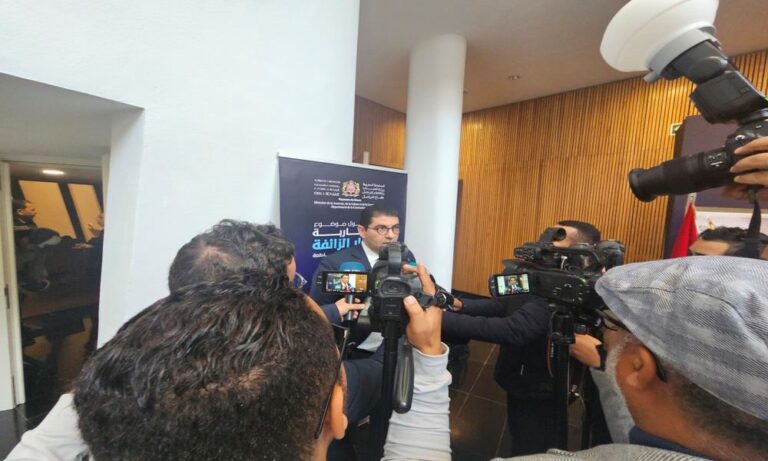
The Minister of Youth, Culture, and Communication, Mehdi Bensaid, called on Wednesday in Rabat for coordinated action between public authorities, the media, and civil society to combat the spread of misinformation, which he described as a major threat in the digital age.
The Moroccan minister warned against the rise of fake news, stating that it now constitutes one of the main risks to social cohesion and trust in institutions.
He was speaking at a meeting held on Wednesday,December 17, under the theme “The Fight Against Fake News: Approaches and Perspectives.”
According to the minister, disinformation is no longer simply a matter of technical errors or inaccuracies. He asserted that it has become a structural phenomenon capable of sowing confusion, distorting facts, and undermining the credibility of public institutions.
Mr. Bensaid reiterated that the right to access reliable information is guaranteed by the Moroccan constitution and constitutes an essential foundation of democracy as well as a lever for sustainable development.
Speaking about the impact of the digital revolution, the minister emphasised that while it has facilitated public access to information, it has also brought with it abuses. The speed of dissemination, particularly on social media, often comes at the expense of journalistic professional standards, he argued. “The pressure of immediacy fosters the spread of rumors and misleading content, sometimes without any fact-checking,” he stated, highlighting the limitations of an information ecosystem that he considers increasingly fragmented.
Mehdi Bensaid stressed that the fight against disinformation cannot be undertaken by a single actor. It requires, he asserted, close cooperation between public institutions, professional media outlets, civil society, academia, and digital platforms.
For the minister, clear, timely, and data-driven institutional communication remains one of the most effective ways to counter the spread of fake news.
The government official also emphasised the role of professional journalism, particularly investigative journalism and fact-checking mechanisms. Support for credible media outlets, both public and private, is presented as a central issue for preserving transparency and public trust. In this context, he reiterated that Morocco is continuing to strengthen its legal and institutional framework to guarantee press freedom and promote responsible journalism, in accordance with the principles enshrined in the 2011 constitution.
He stressed the importance of media literacy, especially for young people. The stated objective is to transform them from passive consumers of content into citizens capable of critical analysis and
possessing a heightened digital awareness. To this end, the ministry supports training programs, university initiatives, and awareness campaigns, notably through the Higher Institute of Information and Communication, describing disinformation as a lasting threat to cultural values and collective memory.
For her part, the President of the High Authority for Audiovisual Communication (HACA), Latifa Akharbach, emphasised that combating disinformation and deconstructing false and manipulative narratives requires coordinated public action.
According to her, a sustainable and effective fight against disinformation inevitably requires adopting an approach based on shared responsibility and coordinated action within the framework of genuine public policies.
She believes that these public policies should guarantee the lasting establishment of the necessary
conditions, in terms of fundamental freedoms, media and regulatory professionalism, civic education, and technological proficiency, in order to anticipate and manage informational risks that threaten national cohesion and the proper functioning of the democratic sphere.
Akharbach highlighted the central role of professional media in the fight against disinformation, calling for strengthening their capacity to fulfill this role by focusing on the quality and credibility of
their content and by working to overcome the various forms of economic, professional, and ethical fragility plaguing the national media ecosystem.
Noting that the global nature of information risks paradoxically necessitates the development of tailored local responses rooted in national realities, the president of the HACA emphasised the
importance of holding digital actors accountable, especially since information disseminated through electronic platforms has a direct impact on the quality of public debate and political life.
During a panel discussion held as part of this meeting, media and digital professionals, publishers, and legal experts underscored the importance of collective, responsible, and coordinated action
requiring the commitment of all stakeholders.
Jamaa Goulahcen, Editor-in-Chief and news anchor at the “2M” Channel, believes that the fight against fake news requires easy access to accurate and official sources of information. He noted that all institutions, regardless of their nature, must be willing to communicate with journalists to provide them with correct information.
For her part, Narjis Rerhaye, a member of the High Council for Audiovisual Communication, emphasised the role of traditional audiovisual media in debunking misinformation. She called for
collective action to contribute to this effort, as well as to contribute to the digital literacy of citizens. “Now more than ever, we should strengthen the role of traditional media, particularly radio and television,” she said, highlighting the need to develop the critical thinking skills of citizens who are confronted with the flow of misinformation. For her, this information is dangerous given the
behaviours it can induce and the models of representation it shapes, hence the need to place greater emphasis on the responsibility of traditional media.
This meeting is part of the efforts of the Ministry of Youth, Culture and Communication to address the numerous problems facing the media and digital landscape, particularly those related to fake news and its repercussions on individuals and society.
AK/mk/ac/fss/as/APA