



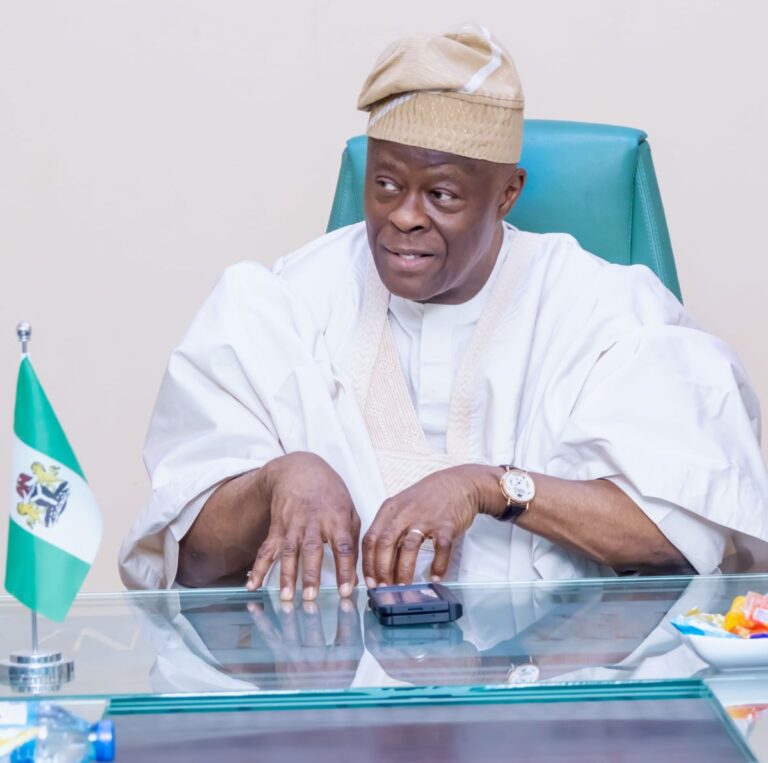
Nigeria’s Minister of Finance and Coordinating Minister for the Economy, Mr Olawale Edun, says that Nigeria has a $14bn annual infrastructure investment gap, for which it continues to seek both domestic and foreign investment.
Speaking at the signing of the 2026–2028 partnership agreement with the Head of the Islamic Development Bank Group, Mr Anasse Aissami, at the IsDB Group Day in Nigeria on Monday in Lagos, Edun said that it had become imperative for the Nigerian government to leverage strategic partnerships to bridge the gap and fast-track development.
According to him, the partnership with the Islamic Development Bank Group will support scalable and transformative projects under the Federal Government’s Renewed Hope Infrastructure Development Fund.
Edun explained that the collaboration is anchored on large-scale financing of sustainable infrastructure projects in roads, rail, ports, energy, agriculture, and digital infrastructure.
“Our strategic partnership with IsDB is to move our priorities to action through scalable, large-scale, transformative projects and initiatives. We have a very important alignment and partnership with IsDB, and it is anchored on two strategic pillars: sustainable infrastructure for economic transformation.
“We are addressing in Nigeria many estimates, one of which is that there is a $14bn annual infrastructure investment gap, and that is being addressed through initiatives such as the Renewed Hope Infrastructure Fund. There are major highways, ports, and rail projects that are being undertaken.
“With IsDB support, we are advancing energy access, renewable power, transport and logistics mobilisation, agriculture productivity and food security, and digital infrastructure, innovation, automation and creative industries,” he said.
According to the minister, the collaboration with the Islamic Development Bank Group would also support human capital development, including investments in health, education, and social impact programmes.
He said the government remained committed to ensuring that infrastructure development translates into job creation, poverty reduction, and improved living standards for Nigerians.
Edun added that, given Nigeria’s growing population and infrastructure needs, there was an urgent requirement to scale up investments in roads, rail, and ports, while also strengthening social protection systems.
He added that the partnership also aligned with the declaration of 2026 as the Year of Social Development, which focuses on human capital and inclusive development.
The minister noted that public financing alone would be insufficient to meet the country’s infrastructure needs, pointing out that the government is shifting towards private sector-led investment and innovative financing models.
He said the government was expanding the use of Islamic finance instruments, including Sukuk, to fund infrastructure, while also exploring asset securitisation and blended finance to attract private capital.
“We are looking at the fact that public financing has its limitations. The government only has so much. In fact, the government is only 10 per cent of the economy; 90 per cent of this economy is the private sector.
“So we need to move from reliance on public to private capital-led growth; from traditional borrowing to innovative financing instruments; from risk exposure to risk sharing and de-risking mechanisms. In simple terms,
Nigeria is repositioning itself as a destination for scalable, bankable investment,” Edun said
Edun added that the partnership also aligns with broader efforts to reposition Nigeria as a leading destination for investment, supported by ongoing economic reforms aimed at stabilising the macroeconomic environment.
He said the reforms, which include the removal of longstanding economic distortions, were beginning to yield results, with inflation showing signs of moderation and investor confidence gradually improving.
In his speech,, the IsDB Group Head of Delegation, Anasse, underscored that the bank was committed to promoting economic development, sustainable growth, strengthening resilience, supporting trade and financing solutions, and capacity building in Nigeria.
He outlined that the partnership is aimed at improving road infrastructure, seaports, health, power, and enhance the quality of education in Nigeria.
Anasse noted that the bank’s portfolio presently covers 21 out of the 36 states, consisting of 148 projects estimated at $2bn in sustainable and inclusive infrastructure, which he said would increase in the coming years.
“The CEF marks a new era of strategic synergy, moving beyond isolated interventions to deliver integrated, federal-scale solutions. We are aligning our institutional resources to support Nigeria’s transition toward a diversified, high-growth economy, one where the private sector serves as the fundamental engine of development,” Anasse said.
GIK/APA